Laser Repair Welding for Precision Component Restoration
Targeted laser welding to repair wear, ひび割れ, and local defects — restoring geometry and performance with minimal heat input.
- Localized material deposition, not full reprocessing
- Minimal heat input and distortion
- Ideal for high-value and precision components
What Is Repair Welding?
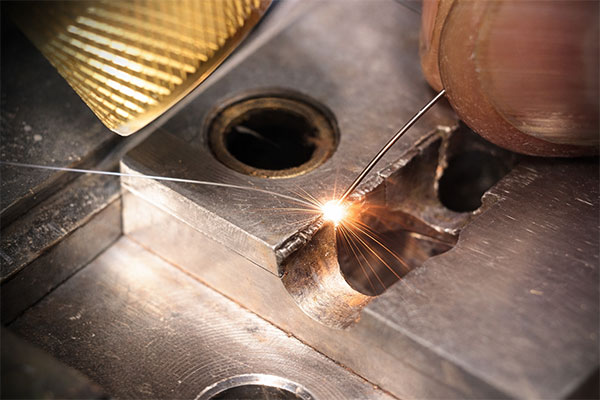
Repair welding is a localized laser-based process used to restore worn, cracked, or damaged areas of metal components.Material is deposited precisely at defect locations to rebuild geometry and recover functional performance. Unlike conventional welding or replacement, laser repair welding focuses on minimum heat input, high positional accuracy, and controlled material addition.
Why Use Laser Repair Welding Instead of Conventional Repair?

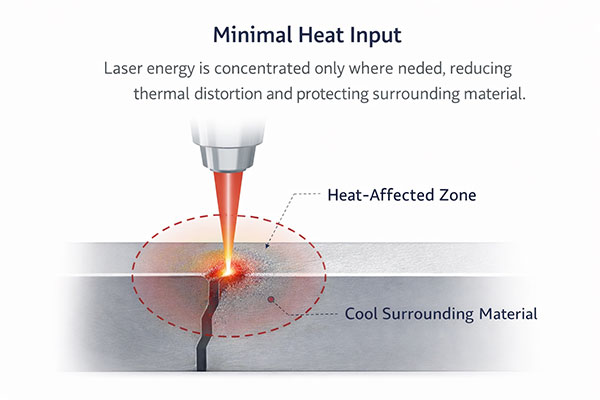
Minimal Heat Input
Laser energy is concentrated only where needed, reducing thermal distortion and protecting surrounding material.
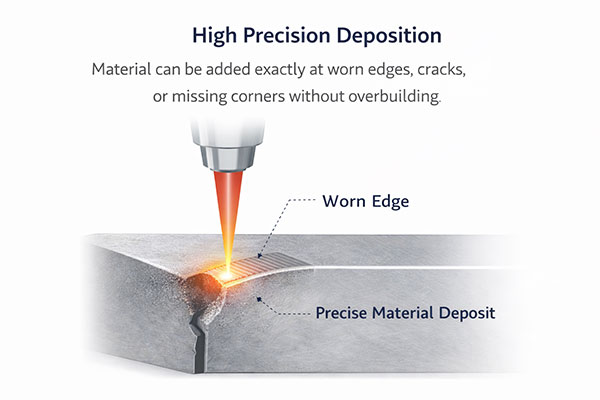
High Precision Deposition
Material can be added exactly at worn edges, ひび割れ, or missing corners without overbuilding.
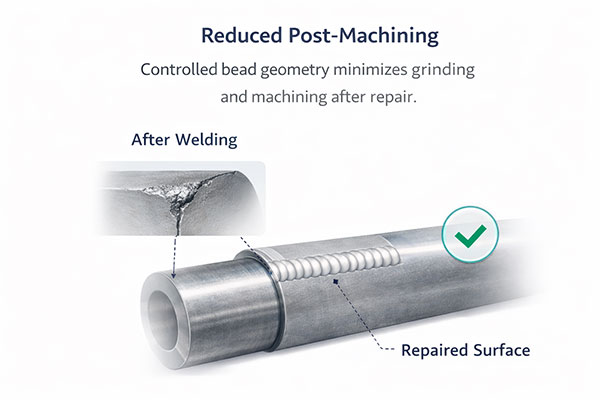
Reduced Post-Machining
Controlled bead geometry minimizes grinding and machining after repair.
Typical Repair Welding Applications
Mold & Die Repair
Laser repair welding is widely used to restore mold cavities, edges, and parting lines affected by wear or chipping, without altering the original mold geometry.
Typical Defects
- Edge wear and rounding
- Small cracks
- Local chipping or erosion
利点
- Extends mold service life
- Preserves dimensional accuracy
- Avoids full mold replacement
Mechanical Component Repair
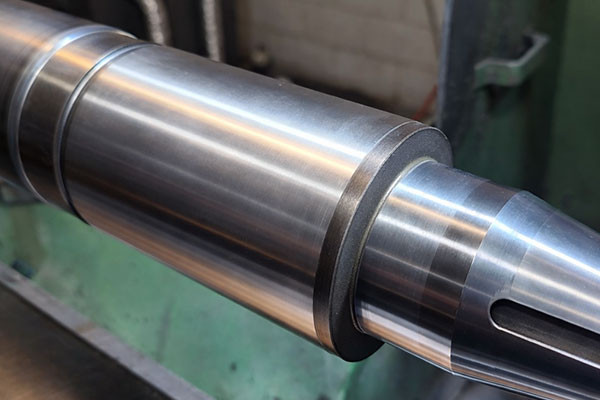
Precision repair welding enables the restoration of shafts, gears, housings, and other mechanical parts with localized damage.
Typical Defects
- Wear grooves
- Impact damage
- Localized cracks
利点
- Restores original dimensions
- Minimal distortion
- Suitable for on-site or workshop repair
Aerospace Maintenance & Repair
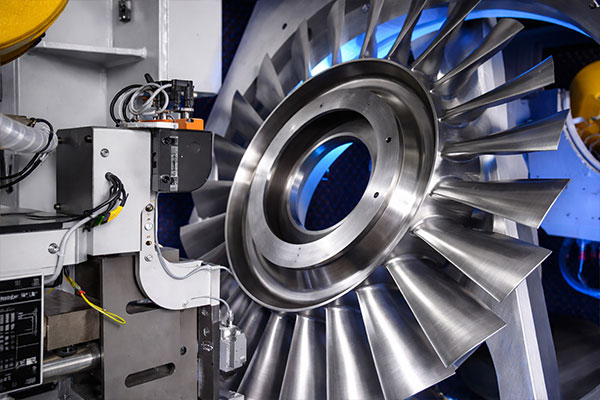
In aerospace maintenance, laser repair welding is used for controlled restoration of high-value components where heat input and metallurgical integrity are critical.
Typical Defects
- Structural components
- Engine-related metal parts
- Precision housings
利点
- Controlled heat-affected zone
- 再現可能, documented repair quality
- Suitable for high-performance alloys
Repair Welding vs Laser Cladding
| Repair Welding | レーザークラッディング |
|---|---|
| ローカライズされた, defect-focused | Area or surface reinforcement |
| Small deposition volume | Larger coating thickness |
| Minimal heat input | Higher but controlled heat input |
| Restore geometry | Enhance surface properties |
| 👉 Repair welding restores; cladding protects or upgrades. | |
Why Diode Lasers for Repair Welding?
Stable Melt Pool
Uniform energy distribution supports controlled melt pools, reducing crack sensitivity during repair.
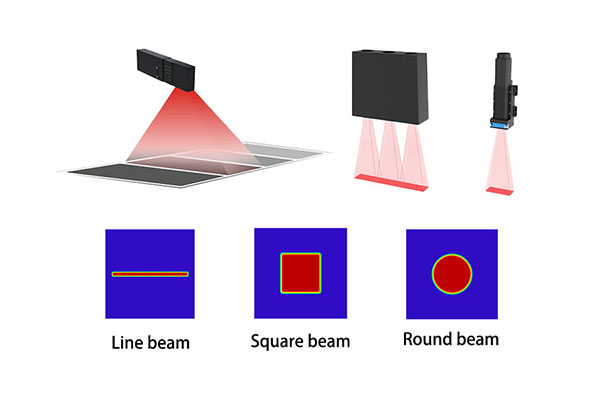
Flexible Beam Size
Adjustable spot sizes allow precise matching to defect geometry.
エネルギー効率
High electrical-to-optical efficiency supports long repair cycles with lower operating cost.
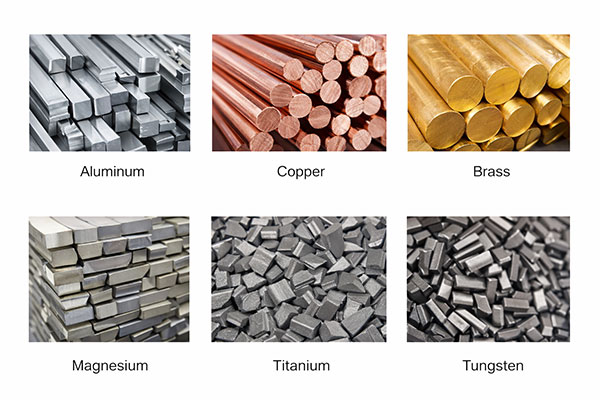
Materials Suitable for Repair Welding
Compatible Materials
Tool steels
Stainless steels
Carbon and alloy steels
Nickel-based alloys
Cobalt-based alloys
(Copper and reflective materials with blue diode lasers)
Here you will find a solution for repair welding

High Power Diode Laser →
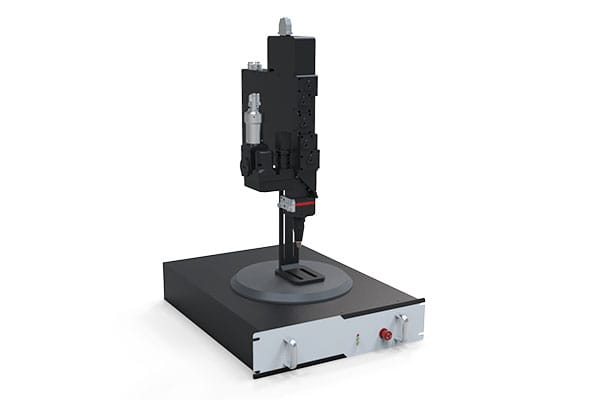
High-power diode laser optimized for precision repair welding. Optional blue diode or hybrid configuration for reflective materials.
なぜ選ぶのか Vivlaser
私たちを際立たせるもの?
- 以上 20 長年のダイオードレーザーの専門知識
- ISO9001による認定, ce, ROHS認定
- 10,000+ M²モダンファクトリー, 100,000+ ユニット年間容量
- トップレーザー業界のリーダーとグローバルデバイスブランドによって信頼されています
- 迅速な配信とレスポンシブグローバルサポート
信頼性のあるVivlaserを選択してください, 規模, そして、実証済みのパフォーマンスパワーあなたのビジネス.