In the world of light, blue lasers are often misunderstood. But in fact, they’re some of the most powerful and precise tools in modern technology.
A blue laser is a type of laser that emits light in the blue region of the visible spectrum, typically around 405–450 nanometers. Its short wavelength means it delivers more energy in a smaller area, making it ideal for high-precision tasks.

What Makes a Blue Laser Different?
Compared to red or infrared lasers, blue lasers have a much shorter wavelength. That means they can be focused into a smaller spot, allowing for higher accuracy and finer detail.
Blue lasers stand out for their high energy density and tight beam focus, making them perfect for engraving, scanning, and other tasks that demand precision.

Why Shorter Wavelengths Matter
| Laser Color | 파장 (nm) | Application Focus |
|---|---|---|
| Red | ~650 | Pointers, alignment tools |
| 적외선 | ~808–1064 | Cutting, welding |
| 파란색 | ~405–450 | Engraving, 마킹, welding high-reflective metals |
Blue lasers are particularly good at interacting with materials that reflect red or infrared light, which gives them a clear advantage in many modern applications.
Where Are Blue Lasers Used?
You might be surprised to know that blue lasers already play a role in your daily life.
From tiny devices like Blu-ray players to industrial laser markers and medical scanners, blue lasers are everywhere.

Everyday Applications
-
Laser projectors and display systems
-
Blu-ray DVD drives
-
Desktop engraving tools for hobbyists
산업 및 과학 응용
-
High-resolution laser marking on plastics and metals
-
Precision medical devices and diagnostic tools
-
Surface treatment in microelectronics
Beyond DIY: High-Power Blue Lasers Are Changing the Industry
Most people associate blue lasers with small devices and hobby-level tools. But behind the scenes, blue lasers are getting a serious power boost.
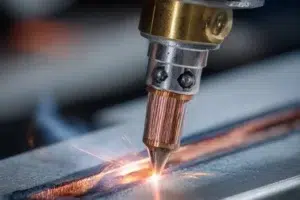
Today’s industrial blue lasers can reach hundreds of watts, and they are now being used to weld metals like copper and gold—materials that are usually very difficult to work with.

Why High Reflective Metals Matter
Materials like copper and gold reflect most of the light from traditional infrared lasers. That makes them hard to weld or engrave with standard systems.
블루레이저, on the other hand, are absorbed more easily by these metals. This results in:
-
Deeper, cleaner welds
-
More stable processing
-
Less energy waste
What Makes High-Power Blue Lasers So Valuable?
High-power blue laser systems are compact, 정밀한, and energy-efficient. They are already being used in:
-
New energy battery welding (예를 들어, EV power cells)
-
Precision electronics assembly
-
3C product manufacturing (computers, communications, consumer electronics)
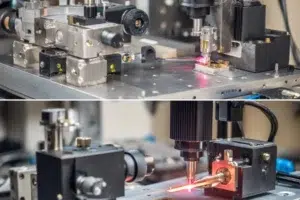
These lasers can be combined with galvanometer scanning systems or robotic arms to handle automated manufacturing tasks, allowing for cleaner, 더 빠르게, and more flexible production.
Summary: A Bright Future for Blue Lasers
From compact engravers to powerful welding tools, blue lasers are proving they’re more than just a pretty color. With growing adoption in industry, medicine, and consumer tech, they’re becoming one of the most versatile laser technologies available today.
As leading companies like Vivlaser continue to push the boundaries—especially in high-power blue laser modules—we’re likely to see even more breakthroughs in the near future.
Blue lasers are particularly effective when processing materials that strongly reflect red or infrared light, which gives them a clear advantage in many modern manufacturing environments.
For a deeper technical overview of industrial-grade blue laser systems and wavelength characteristics, see our 445nm Blue Laser Technology Guide.





One Response
Great info.