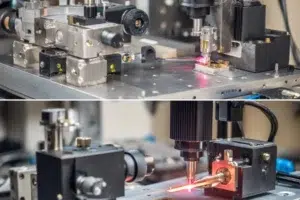
Struggling to find a laser for a specific wavelength? Raman fiber lasers offer a solution, but choosing one can feel like a gamble. How do you ensure performance and reliability?
The key is not just how these lasers create new wavelengths, but how reliably they do it. The success of a Raman laser depends entirely on its internal pump diode. This component's quality dictates the laser's stability, lifespan, and ultimate value for your application.
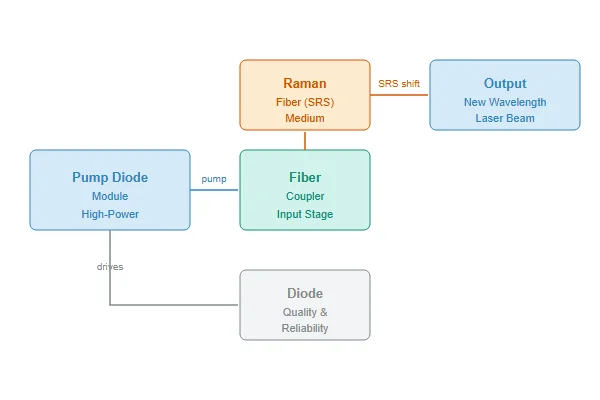
Many engineers focus on the physics of Raman lasers. They want to understand the complex interactions happening inside the fiber. But from our experience analyzing production and reliability data, this is not the most critical question. The more important question is, "How do I choose a system that will work reliably for my specific needs?" The answer almost always comes back to the quality and suitability of the pump source. This article will shift your focus from the "how" to the "how to choose," empowering you to make a better decision.
What Is Stimulated Raman Scattering and How Does It Generate New Wavelengths?
The physics of Raman scattering can seem complex. It's hard to visualize how light changes its color inside a fiber. This complexity can make it difficult to evaluate the technology confidently.
Stimulated Raman Scattering (SRS) is a process where high-power pump light interacts with the glass in an optical fiber. This transfers energy from the pump light, creating a new beam of light at a longer wavelength. This new, longer wavelength is called the Stokes wave.1
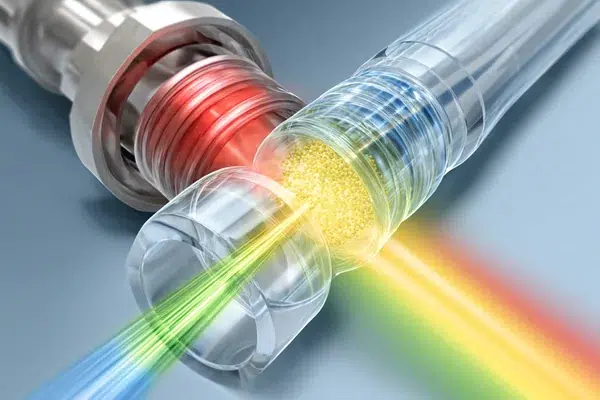
To understand this better, let's break it down. Think of the pump laser as the engine. It provides the energy. The optical fiber is the medium where the work happens.
- High-Power Pump: A powerful laser beam from a pump diode is sent into a long optical fiber. The power needs to be high enough to trigger a nonlinear effect in the glass.
- Interaction with Material: The photons from the pump laser interact with the molecular vibrations of the silica glass in the fiber.
- Energy Transfer: In this interaction, a pump photon loses some energy to the fiber material. Because it has less energy, it emerges as a new photon with a longer wavelength.
- Amplification: This process stimulates other pump photons to do the same thing, creating a chain reaction. This amplifies the new, longer-wavelength light, which becomes a coherent laser beam.
The efficiency of this energy transfer depends directly on the power density of the pump laser. But it's not just about power. If the pump's wavelength or power output fluctuates, the resulting Stokes wave will also be unstable. This is a critical point that many overlook. The stability of the final laser is built upon the stability of the pump source.
| Pump Diode Property | Impact on Raman Laser Output |
|---|---|
| High Output Power | Enables efficient energy conversion |
| Wavelength Stability | Determines the precision of the output wavelength |
| Power Stability | Ensures consistent and reliable output from the Raman laser |
| Beam Quality | Affects how well the pump light couples into the fiber |
Cascaded Raman Shifting: How Can You Reach Wavelengths Between Yb and Er Bands?
Finding lasers in the "telecom gap" between roughly 1.1 µm and 1.7 µm is a common challenge. Standard technologies like Ytterbium (Yb) and Erbium (Er) lasers don't operate here, limiting many research and industrial applications.
Cascaded Raman shifting solves this by using the output of one Raman process to pump the next one. This creates a series of wavelength shifts, like steps on a ladder, allowing us to generate custom wavelengths in these hard-to-reach spectral regions.
The concept is simple but powerful. The first Stokes wave, created by the initial pump diode, is itself powerful enough to act as a pump source. When it travels down the fiber, it generates a second Stokes wave at an even longer wavelength. This process can be repeated multiple times.
- Step 1: An initial pump laser (e.g., at 1064 nm) generates the first Stokes wave (e.g., around 1120 nm).
- Step 2: The 1120 nm Stokes wave acts as a new pump, generating a second Stokes wave (e.g., around 1180 nm).
- Step 3: This continues, with each new Stokes wave pumping the next one.
This technique is incredibly flexible. By controlling the initial pump wavelength and the fiber properties, we can create lasers at very specific wavelengths that were previously unavailable. However, our internal data shows a clear pattern: each "step" in the cascade introduces a potential point of instability. Any fluctuation in the initial pump diode's power or wavelength is magnified at each subsequent step. The stability of the final output wavelength depends on the stability of every step before it. This all traces back to the original pump diode. This is why we place so much emphasis on the long-term aging tests of our pump diodes. The foundation must be solid.
What Are the Key Pump Source Requirements for Raman Fiber Lasers?
You are looking at a spec sheet for a pump diode. It lists high power and a specific wavelength. But what do these numbers really mean for your Raman laser's performance, reliability, and total cost of ownership?
Beyond raw power, the most critical requirements for a pump source are wavelength stability, power stability, and long-term reliability. A wavelength-locked diode prevents drift, and a robust thermal design ensures consistent power. These factors determine the laser's real-world value.
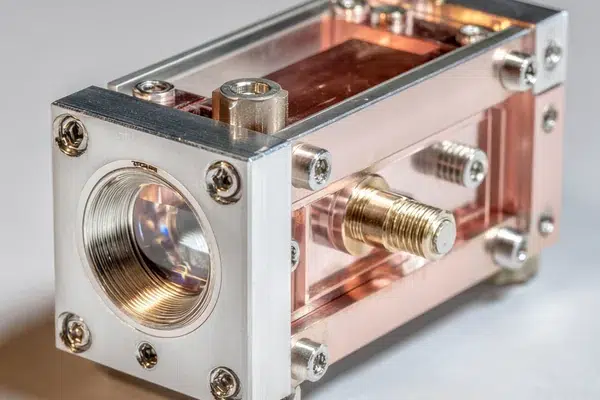
A spec sheet only tells part of the story. To truly evaluate a pump source, you need to ask deeper questions. Our analysis of system failures and performance degradation consistently points to three key areas that are often overlooked.
Wavelength Stability: Beyond the Spec Sheet
A standard diode's wavelength can drift with changes in temperature or operating current. In a Raman laser, this directly causes the output wavelength to drift, which is unacceptable for precision applications like spectroscopy. Wavelength-stabilized diodes, often using a Fiber Bragg Grating (FBG), lock the output to a precise wavelength. This prevents drift and ensures the Raman laser's output is consistent and accurate.
Power Stability and Thermal Management
High-power diodes generate a lot of heat. If this heat is not managed effectively, the diode's performance will degrade. Its power output will drop, and its lifespan will shorten. A well-designed pump module includes advanced thermal management to draw heat away from the laser chip efficiently. This ensures stable power output over long operating hours and protects the diode from premature failure.
Reliability and Lifespan: What Aging Tests Reveal
A pump diode might perform perfectly on day one, but how will it perform after 10,000 hours? This is where long-term aging data is critical. Reputable manufacturers perform extensive reliability testing, including high-temperature storage and long-term operational tests. This data is the best predictor of a diode's true lifespan and reliability.
Here are the questions you should be asking any potential supplier:
| Standard Spec Sheet Metric | The Critical Question to Ask Your Vendor |
|---|---|
| Peak Output Power (W) | What is the power stability over 24 hours of continuous operation at max output? |
| Center Wavelength (nm) | Is the wavelength locked with an FBG? What is the wavelength shift per degree Celsius? |
| Operating Current (A) | What does the long-term aging data show about performance degradation over 10,000+ hours? |
| Module Dimensions (mm) | Can you share the thermal resistance data for the package design? |
What Are the Main Applications, Like Spectroscopy and Materials Processing?
You have a specific task, but it's not clear if a Raman laser is the right tool. How do you know if it fits your needs for precision scientific measurements or demanding industrial production?
Raman lasers are highly versatile. They are used in spectroscopy for their wavelength precision, in telecom for signal amplification, and in materials processing for working with materials that absorb light poorly at standard laser wavelengths. The key is matching the pump to the application.
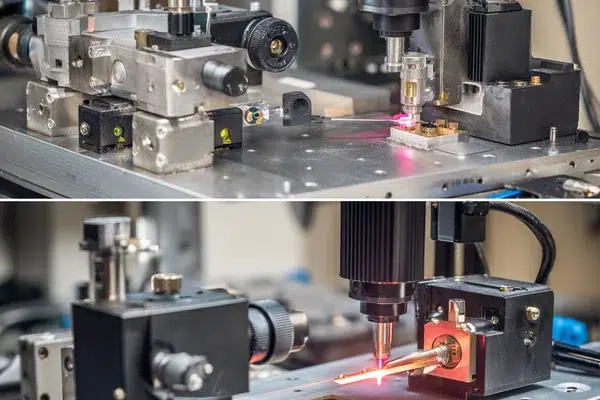
The choice of a Raman laser, and more specifically its pump source, is not a one-size-fits-all decision. The requirements change dramatically depending on the end use. Let's compare two common scenarios we see among our customers.
For Scientific Spectroscopy
In applications like Raman spectroscopy or biomedical imaging, wavelength precision is everything. A tiny drift in the laser's wavelength can make an entire measurement useless. For these customers, the most important feature of the pump diode is its wavelength stability. A wavelength-locked pump source with excellent thermal management is non-negotiable. The goal is to eliminate any source of wavelength variation. Power stability is also important, but it comes second to the absolute accuracy of the wavelength. These applications demand the highest level of precision from the pump diode to ensure the scientific data is accurate and repeatable.
For Industrial Materials Processing
In an industrial setting, such as welding or cutting specific polymers or metals, the priorities shift. Here, the laser might run for three shifts a day, five days a week. The most important factors are long-term reliability and power stability. Downtime for maintenance or replacement is extremely costly. For these applications, a robust pump diode with proven long-term aging data and a rugged package is essential. It must deliver consistent power hour after hour in a potentially harsh factory environment. While the exact wavelength is important, a small amount of drift is often more tolerable than a sudden drop in power or unexpected failure. The focus is on maximizing uptime and ensuring a low total cost of ownership.
Why Are Raman Lasers Growing for Industrial and Medical Use?
Raman lasers used to be complex tools found only in research labs. Now, we see them being designed into industrial machines and medical devices. What changed to make them reliable enough for these fields?
The rapid growth of Raman lasers is directly tied to advances in high-power semiconductor pump diodes. Modern diodes are more powerful, stable, and reliable than ever. This has made Raman systems smaller, more cost-effective, and robust enough for real-world applications.
Based on our industry analysis, the story of the Raman laser's success is really the story of the pump diode's evolution. In the past, pump sources were bulky, inefficient, and had short lifespans. This made Raman lasers expensive, unreliable, and too delicate for use outside a controlled lab. But that has changed due to key manufacturing improvements.
- Improved Chip Technology: Advances in semiconductor material science have led to laser diode chips that are more efficient and can handle higher power densities without degrading.
- Advanced Facet Coatings: The laser's facets, where the light exits the chip, are extremely delicate. Modern coating technologies protect these facets from damage, dramatically increasing the diode's lifespan and reliability at high power levels.
- Automated Packaging and Testing: High-volume, automated assembly processes have improved the consistency and quality of pump diode modules. By combining this with rigorous, automated testing and quality control at every step, we can identify and eliminate potential failures before they ever leave the factory.
Our analysis of production data shows a clear trend: as manufacturing processes for pump diodes have matured, the field-reported reliability of the final Raman systems has increased significantly. System integrators now have a higher level of trust in the technology. They are no longer buying a science experiment; they are buying a reliable industrial or medical tool.
Conclusion
Choosing the right Raman laser is not about complex physics. It's about asking the right questions about the pump diode to ensure long-term stability, reliability, and performance for your specific needs.
"Stokes wave - Wikipedia", https://en.wikipedia.org/wiki/Stokes_wave. In the context of Raman scattering, the light generated at a longer wavelength, corresponding to a loss of energy from the incident pump photon, is referred to as the Stokes wave. Evidence role: definition; source type: encyclopedia. Supports: The term 'Stokes wave' refers to the down-shifted frequency (longer wavelength) light generated in a Raman scattering process.. ↩