MLCP (Microchannel Liquid Cooling Plate) is quickly becoming the new frontier in AI chip thermal management. But manufacturing these micro-structured copper components remains a major bottleneck. Could blue lasers help change that?
While not yet widely adopted, blue lasers are being explored as a potential tool for high-precision MLCP 3D printing. Vivlaser is currently investigating their feasibility in metal additive manufacturing.

As MLCP reshapes how we cool high-performance chips, new demands are emerging on the tools needed to build these microfluidic structures. Among these tools, blue lasers are gaining interest—not as the main character, but as a promising technical supporting role.
What Is MLCP? And Why Is It Becoming the Go-To Solution for AI Chip Cooling?
AI chips consume more power than ever. Traditional air cooling is outdated, and even liquid cold plates are hitting limits.
MLCP (Micro Liquid Cooling Plate1) is a liquid cooling technology integrated directly into the chip package. It embeds micron-sized flow channels in the metal cover or substrate, allowing coolant to flow directly over the chip’s heat source, drastically reducing thermal resistance2 and boosting heat exchange.

MLCP Structure and Cooling Mechanism
-
Ultra-fine flow channels: Typically under 100μm wide, thinner than a hair.
-
Source-contact cooling: Coolant flows directly over the chip, bypassing interface layers.
-
Integrated construction: Channels are built into chip lids or substrates.
-
Pumped system: Coolant is forced through channels at high speed to carry away heat.
MLCP vs Traditional Liquid Cooling
| ميزة | Traditional Liquid Cooling | MLCP Technology | Analogy |
|---|---|---|---|
| Heat Path | Indirect, via thermal interfaces | Direct, coolant contacts heat source | Ice pack vs. IV injection |
| Channel Size | >0.3مم | <100ميكرومتر | Highway vs. Capillary |
| Cooling Efficiency | معتدل | 3–5× higher | Fan vs. Industrial blower |
| Thermal Resistance | 0.03–0.05℃·cm²/W | <0.015℃·cm²/W | Thick coat vs. Cold plunge |
Why AI Chips Must Embrace MLCP
-
Next-gen chips like Blackwell/MI300 exceed 2000W
-
Chip sizes stay constant → heat flux > 1kW/cm²
-
Air and contact cooling can’t handle the heat anymore
How Are MLCPs Made? Why Is 3D Printing the Breakthrough?
MLCP sounds great—but it’s extremely difficult to manufacture. How do you carve out dozens of micron-wide channels in metal?
Traditional methods like etching and brazing are expensive and prone to leaks. 3D printing3—especially laser-based metal additive manufacturing4—is now the leading alternative.
MLCP Manufacturing Method Comparison
| طريقة | المزايا | العيوب |
|---|---|---|
| Etching + Brazing | دقة عالية, proven tech | Expensive, leakage risks, complex structure |
| Micro-Extrusion / Stamping | Low cost, قابلة للتطوير | Limited channel complexity |
| Metal 3D Printing | One-piece design, complex shapes | Low speed, material processing challenges |
Why Laser-Based 3D Printing Suits MLCPs
-
Enables micro-scale structures <100ميكرومتر
-
One-piece sealed design avoids leaks
-
Supports complex, custom flow layouts (Z-shaped, wave, biomimetic)
Copper Is Hard to Print—Why Blue Lasers Are Worth Exploring
Copper is thermally excellent but hard to process. Infrared lasers reflect off it almost entirely.
الليزر الأزرق5 have shorter wavelengths and higher energy density. Their absorption in copper is far better than infrared lasers, making them an interesting candidate for MLCP printing6.
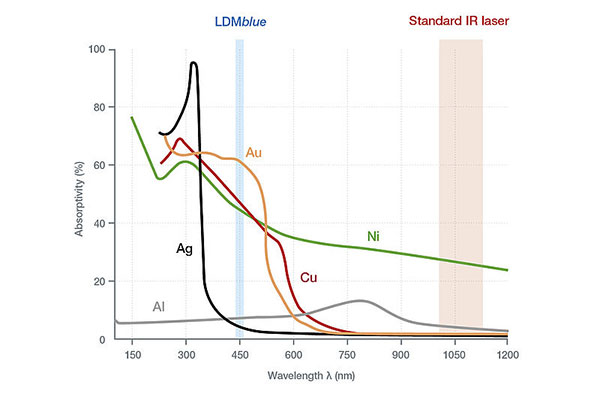
Laser Wavelength vs. امتصاص النحاس
| الطول الموجي | Copper Absorption Rate | Typical Use |
|---|---|---|
| Infrared (1064نانومتر) | <10% | Common fiber lasers, poor on copper |
| Green (515نانومتر) | ~30% | Moderate performance |
| أزرق (450نانومتر) | >40% | Best for copper processing |
Why Blue Lasers May Be Suitable for MLCP 3D Printing
-
Higher absorption → more efficient melting of copper
-
Shorter wavelength → higher resolution
-
Potential compatibility with next-gen metal printers
What Role Does Vivlaser Play in This Landscape?
Vivlaser is not producing MLCPs, but it is closely watching this manufacturing trend.
As a supplier of high-power blue lasers, Vivlaser is currently researching their application in the 3D printing of copper-based MLCP structures. This work remains experimental, but reflects a growing industry interest.
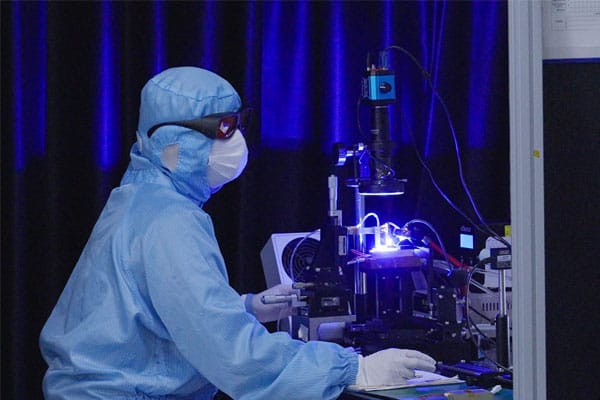
Vivlaser Blue Laser Core Specs
| المعلمة | Typical Values |
|---|---|
| الطول الموجي | 445–455nm |
| طاقة الإخراج | 50W–300W per module |
| جودة الشعاع | M² < 5, multimode optimized |
| Focus Spot Size | <50ميكرومتر |
| نظام التبريد | TEC + Water |
| Operation Mode | CW or Pulsed |
Built for Research, Adaptable for Integration
-
Compact laser modules for OEMs
-
Multi-fiber configurations possible
-
Designed for thermal stability and long service life
خاتمة
MLCP technology is reshaping the future of chip cooling. Blue lasers are not the main character—but they may soon become an important tool in how we manufacture the coolers of tomorrow. Vivlaser is paying attention—and building toward that future.
-
Explore this link to understand the innovative technology behind MLCP and its advantages in AI chip cooling. ↩
-
Learn about thermal resistance and its critical role in cooling technologies, especially for high-performance AI chips. ↩
-
Explore how 3D printing revolutionizes manufacturing with its unique advantages, especially in creating complex designs. ↩
-
Learn about the innovative process of laser-based metal additive manufacturing and its impact on precision engineering. ↩
-
Explore how blue lasers enhance copper processing efficiency and resolution, making them a game-changer in 3D printing. ↩
-
Learn about MLCP printing and its benefits, especially in the context of advanced metal printing technologies. ↩