UV and ultrafast solid-state lasers rely on a key component that often goes unnoticed—the pump laser. Engineers tend to focus on output power or application results, but forget that system stability starts with the pump source.
In UV and ultrafast lasers, the pump laser isn’t a secondary accessory. It is the system’s ignition point and long-term performance anchor.
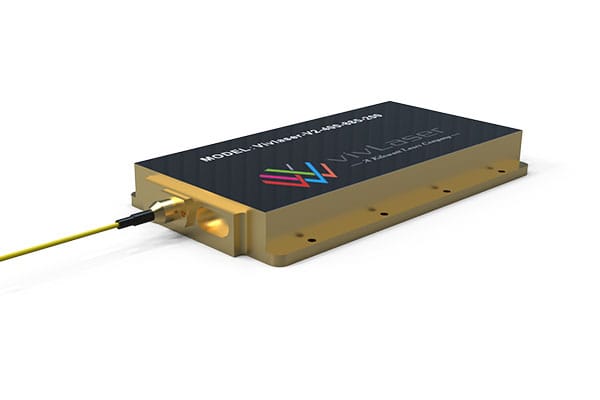
Choosing the right pump laser isn’t just about specifications. It’s about compatibility with your gain crystal, spectral alignment, thermal behavior, und mehr. This guide breaks down everything you need to know.
What Role Does the Pump Laser Play in UV and Ultrafast Solid-State Lasers?
Every solid-state laser needs energy input. That energy comes from the pump laser1.
Der pump laser1 initiates population inversion2 in the gain medium, and its precision determines system stability, Effizienz, und Lebensdauer.

If the pump source is unstable, misaligned, or thermally mismatched, the whole system suffers. This is why pump laser1s are central to system architecture—not just power supplies.
How Gain Crystal Selection Determines Pump Wavelength Requirements
Many engineers begin with desired output power. But in UV and ultrafast systems, crystal choice comes first.
Each gain crystal3 has a narrow absorption peak. Your pump wavelength4 must match it precisely to ensure efficient energy transfer.
For example, Nd:YVO₄ has an absorption peak at 878.6 nm, which demands a narrow-linewidth pump source. Yb:YAG used in ultrafast systems requires pumping at 940 or 969 nm. Misalignment leads to poor gain, excessive heat, and reduced beam quality.
Why Pump Wavelength Matching Matters More Than Pump Power
Power is important, but spectral alignment matters more5.
If the pump wavelength doesn’t match the crystal’s absorption peak, most of the energy is wasted as heat, not laser gain.
This leads to quantum defect6, a thermal burden that affects beam stability. Proper wavelength matching reduces thermal lensing, increases gain, and improves overall system efficiency.
Key Differences Between Pumping UV Lasers and Ultrafast Lasers
Although both UV and ultrafast lasers use solid-state technology, their pump laser requirements differ.
UV lasers require frequency doubling/tripling7, while ultrafast lasers prioritize low thermal loads8 and short pulse stability.

UV systems typically use Nd-based crystals, which demand stable pumping around 808 Zu 885 nm. Ultrafast systems use Yb-doped crystals, optimized for narrow-band pumping around 940 Zu 969 nm, requiring high pulse fidelity and low thermal stress.
Narrow Linewidth vs Broad Spectrum: Why Spectral Control Is Critical
A pump laser’s linewidth affects how efficiently the gain crystal absorbs energy.
Narrow-linewidth (locked-wavelength) pump sources9 enable high absorption efficiency, especially in crystals with narrow absorption bands.

For instance, gesperrt 878.6 nm sources are critical in Nd:YVO₄ systems. Similarly, stabilized 940/969 nm lasers ensure optimal Yb:YAG performance in femtosecond setups. Broad-spectrum sources introduce instability and waste.
Thermal Management Considerations in High-Stability Laser Systems
Thermal issues are a silent killer in laser systems.
Pump lasers influence heat generation, cooling requirements, and overall system stability.
If the pump laser has poor thermal design or mismatched wavelength, it causes heat buildup, leading to thermal lensing, beam drift, and reduced device life. Choosing low quantum-defect wavelengths and efficient cooling structures helps mitigate these risks.
Beam Quality and Coupling Efficiency in Pump Laser Design
Pump beam quality impacts how much energy enters the gain crystal.
High coupling efficiency ensures that the pump energy overlaps well with the laser cavity mode, improving overall system efficiency.
Key parameters include NA, fiber core size, and spatial beam profile. Mismatch in beam shape or intensity leads to mode distortion or incomplete gain.
Long-Term Stability and Lifetime Requirements for Industrial Systems
Research labs need short-term performance. Industrial systems need long-term reliability.
Pump lasers in industrial setups must operate stably for thousands of hours under harsh conditions.
This means high thermal endurance, low failure rates, and tight spectral control. It also requires robust packaging, clean fiber coupling, and excellent after-sales support.
Warum 885 nm / 888 nm Are Common Choices for Modern Ultrafast and UV Lasers
Newer systems prefer 885 or 888 nm over traditional 808 nm.
These wavelengths better match absorption peaks and reduce thermal load, making them ideal for modern high-performance designs.
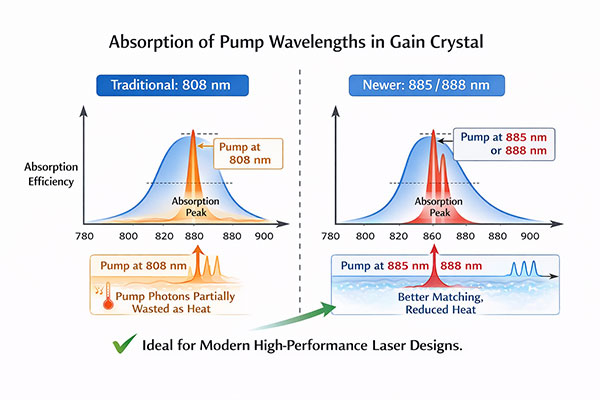
Locked-wavelength modules at 885/888 nm offer greater beam quality and thermal stability, which is critical for both UV and ultrafast platforms. This is now an industry-wide trend.
Common Pump Laser Selection Mistakes in UV and Ultrafast Laser Design
Many failures are due to poor pump choices.
Common mistakes include choosing pump lasers by power rating alone, ignoring spectral width, and neglecting thermal implications.
Other errors: assuming off-the-shelf modules are sufficient, neglecting mode overlap, or not verifying long-term reliability. Always consult crystal absorption data first.
How to Evaluate a Pump Laser Supplier Beyond Datasheets
Specs are just a starting point.
Real evaluation includes reliability testing, customization capabilities, supply consistency, and technical support.
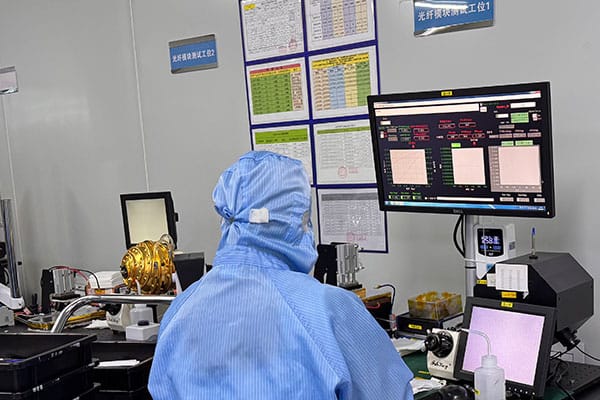
Look for suppliers with proven industrial deployments, cleanroom assembly, and spectrum-locking technology. Ask about their feedback systems, production scale, and after-sales service.
👉 At Vivlaser, we provide all of the above. Our 878.6 nm, 885 nm, Und 888 nm locked-wavelength pump sources are trusted by leading laser manufacturers across Asia and Europe. With in-house R&D, precision assembly lines, and responsive technical support, we ensure every module meets your system-level requirements.
Engineering Summary: A Practical Checklist for Pump Laser Selection
-
Start with the application, not the power
-
Choose the right gain crystal
-
Match pump wavelength to absorption peak
-
Prefer locked-wavelength modules for narrow absorption
-
Consider beam quality and fiber coupling
-
Evaluate thermal management design
-
Review supplier’s industrial experience
-
Check for certifications and test reports
-
Plan for long-term reliability
-
When unsure, consult experienced partners
Pump laser selection isn’t just technical—it’s strategic. Reach out to our Laser Diode Pump Source Technology Guide for expert guidance tailored to your system needs.
-
Understanding the function of pump lasers is crucial for optimizing laser performance and efficiency. ↩ ↩ ↩
-
Exploring population inversion will enhance your knowledge of laser operation and its importance in achieving high performance. ↩
-
Understanding gain crystals is crucial for optimizing laser performance and efficiency in various applications. ↩
-
Exploring pump wavelength effects can enhance your knowledge of laser efficiency and energy transfer. ↩
-
Understanding spectral alignment can significantly enhance laser efficiency and performance, making it crucial for optimal system design. ↩
-
Exploring quantum defect will provide insights into energy loss in lasers, helping you optimize performance and reduce thermal issues. ↩
-
Understanding frequency doubling/tripling is crucial for grasping how UV lasers operate efficiently. ↩
-
Exploring the significance of low thermal loads can enhance your knowledge of ultrafast laser performance and stability. ↩
-
Explore this link to understand how narrow-linewidth pump sources enhance absorption efficiency in laser systems. ↩