Modern laser technology has opened up exciting applications across industry, medicine, and research—but not all lasers are created equal. Red and blue lasers differ in fundamental ways, each with distinct advantages and ideal use cases.
Red and blue lasers differ in wavelength and semiconductor materials, leading to distinct optical, 熱, and application characteristics.

Understanding these differences helps engineers, researchers, and OEMs make better design decisions.
What defines a blue or red laser in terms of wavelength and operating principle?
In the semiconductor laser world, color is a function of wavelength. Red lasers1 typically operate at wavelengths between 630 そして 690 nm, while blue lasers fall in the 405 to 488 nm range.
Red lasers1 use AlGaInP semiconductors and emit around 630–690 nm; blue lasers use GaN semiconductors and emit around 405–488 nm.

Semiconductor Differences and Emission Principles
Red lasers1 diodes (LDs) are based on Aluminum Gallium Indium Phosphide (AlGaInP). They are relatively easy to manufacture and integrate due to mature processes. 青色レーザー2, however, are based on Gallium Nitride (GaN), often grown on sapphire or SiC substrates. These materials present challenges in epitaxy and heat management, but offer higher photon energy.
| 特徴 | Red Laser | ブルーレーザー |
|---|---|---|
| Wavelength Range | 630–690 nm | 405–488 nm |
| LD Chip Material | AlGaInP | GaN |
| Substrate | GaAs | Sapphire/SiC |
| Manufacturing Maturity | 高い | 中くらい |
| Heat Management Needs | 適度 | 高い |
Red and 青色レーザー2 both operate on the principle of stimulated emission in a PN junction. しかし, the shorter wavelength of blue lasers increases photon energy, which means more thermal stress. This requires advanced cooling and packaging design—a field where Vivlaser has accumulated deep expertise.
What materials interact differently with blue and red laser wavelengths?
Laser wavelength plays a critical role in how materials absorb energy. This determines the efficiency and quality of processes like welding, 切断, and medical treatment.
青色レーザー2 are better absorbed by reflective metals like copper and gold, while red lasers are ideal for organic materials like plastics and tissue.
Absorption Efficiency and Material Suitability
Materials like copper and gold reflect most infrared and red light. 青色レーザー, thanks to their shorter wavelength and higher photon energy, overcome this with significantly better absorption.
| 材料 | Absorption (Blue) | Absorption (Red) | Application Fit |
|---|---|---|---|
| 銅 | 高い | 低い | Battery welding |
| アルミニウム | 高い | 低い | Fine metal processing |
| Plastic | Low-Medium | 高い | 医学, consumer devices |
| Skin Tissue | 低い | 高い | Aesthetic treatment |
In industries like EV battery manufacturing, where copper tab welding is critical, Blue lasers deliver unmatched efficiency. For dermatology or barcode scanning, red lasers remain the preferred choice due to their penetration depth and visible beam.
What are the core applications of blue lasers in modern industry?
The unique interaction of blue light with materials opens up cutting-edge applications across precision manufacturing, new energy, and advanced optics.
Blue lasers are used in battery tab welding, マイクロエレクトロニクス, semiconductor packaging, laser display, そして micro/nano-processing3.

Application Landscape and Technical Advantages
Lithium Battery Welding
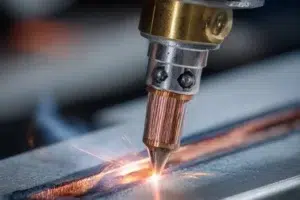
Blue lasers are a game-changer in joining copper tabs with minimal spatter and high joint reliability. Their better absorption reduces power consumption and heat-affected zones.
Semiconductor Packaging
In flip-chip bonding and wafer-level processing, blue lasers enable fine feature resolution and low thermal stress. Vivlaser’s high-stability blue modules are already used by major packaging OEMs.
Laser Display Systems
High-luminance and high-contrast visuals rely on pure blue wavelengths. Blue lasers also serve as primary light sources in projection systems.
Micro/Nano Fabrication
Shorter wavelengths enable tighter focus and more precise ablation. This is vital in areas like glass cutting, circuit editing, and micro-drilling.
| Sector | Benefit of Blue Laser | Vivlaser Solution |
|---|---|---|
| EV Battery | Efficient copper welding | High-power blue laser modules |
| Semiconductors | Low thermal impact | コンパクト, stable diode modules |
| Displays | High brightness | Tuned blue laser systems |
| Microprocessing | Submicron precision | Fiber-coupled blue modules |
なぜ Red lasers1 remain the mainstream in low-power and aesthetic applications?
While blue lasers excel in demanding tasks, Red lasers1 still dominate in many commercial and medical environments.
Red lasers1 are popular in barcode scanning, alignment tools, medical diagnostics, and aesthetic devices due to cost, 安全性, and visibility.**

Simplicity, Visibility, and Maturity
Red LDs are cost-effective and have mature supply chains. They are easy to integrate with simple optics and minimal thermal controls.
In the medical field, red light (especially near-IR) penetrates skin more deeply, making it ideal for therapeutic and aesthetic use.
| 応用 | Reason for Red Laser Use |
|---|---|
| Barcode Scanner | High visibility, low cost |
| Laser Pointer | Safe, eye-visible beam |
| Dermatology | Deep skin penetration |
| Education Tools | 単純, robust design |
Vivlaser offers a full line of red and near-infrared modules, optimized for stable output and integration into OEM aesthetic platforms.
How do performance, 料金, and integration differ between red and blue lasers?
Choosing a laser involves evaluating system requirements, 料金, and ease of integration. Red and blue lasers have clear trade-offs.
Blue lasers offer higher focusability and absorption for metals; red lasers offer better efficiency and lower integration cost.
Performance Trade-Offs and Design Considerations
| 要素 | ブルーレーザー | Red Laser |
|---|---|---|
| Photon Energy | 高い | 中くらい |
| Absorption (金属) | 素晴らしい | 貧しい |
| Optical Focus | Tighter | Wider |
| Wall-plug Efficiency | ~20-30% | ~40-50% |
| Cooling Need | 高い | Low-Moderate |
| System Cost | より高い | より低い |
| Maturity | Growing | Mature |
青色レーザー2 typically require better cooling systems, higher-precision optics, and tighter assembly tolerances. Red systems are more plug-and-play, ideal for cost-sensitive or space-constrained platforms.
How to choose between blue and red lasers for your specific application?
The right choice depends on your material, desired output, and integration environment. A wrong decision could compromise performance or escalate system cost.
Choose blue lasers for high-reflectivity metals and precision; choose red lasers for biological or budget-sensitive applications.
Application-Based Guidance from Vivlaser
For Industrial Manufacturers
If your product involves copper, 金, or requires micron-scale features, our high-power blue modules offer reliable, efficient solutions.
For Medical Device OEMs
For applications in dermatology, ophthalmology, or dental treatment, our red and near-IR modules combine efficacy with integration simplicity.
For Research Institutions
We offer multi-wavelength diode arrays ideal for spectroscopy, fluorescence studies, or advanced imaging. Custom configurations available on demand.
| User Type | Recommended Laser | Reason |
|---|---|---|
| Battery Manufacturer | Blue | Metal absorption, weld quality |
| Aesthetic Equipment OEM | Red/NIR | Skin interaction, thermal profile |
| Lab Researcher | 多波長 | Experimental flexibility |
Vivlaser supports every client with tailored beam shaping, 熱制御, and integration consultation—ensuring the laser fits perfectly into your solution.
結論
Blue and red lasers each have their strengths. Choosing the right one means matching wavelength to your material and system needs—Vivlaser helps you do just that.
-
Explore this link to understand the unique features and uses of Red lasers in various technologies. ↩ ↩ ↩ ↩ ↩ ↩
-
Discover the benefits and applications of Blue lasers, including their role in advanced technologies. ↩ ↩ ↩ ↩
-
Discover the advancements in micro/nano-processing techniques enabled by blue lasers for precision and efficiency. ↩