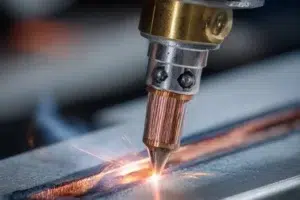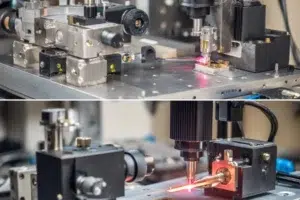
Pain points in material treatment: traditional heating methods are inefficient, lack precision, and often damage delicate surfaces.
Laser annealing and laser hardening are advanced surface treatment technologies with different goals—one repairs internal structure, the other reinforces it.
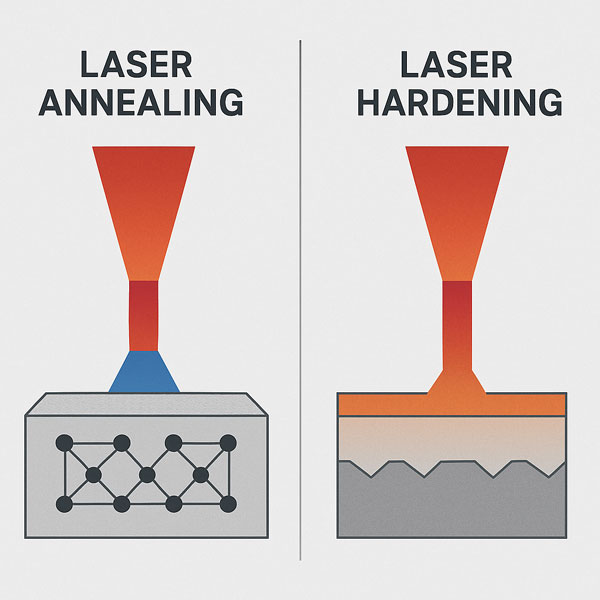
Laser processing is transforming high-end manufacturing. Understanding the difference between annealing and hardening can help you choose the right method for your application.
What is laser annealing used for?
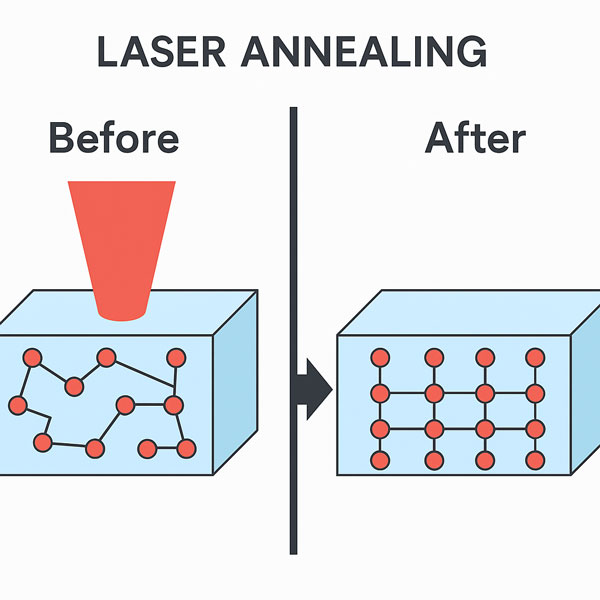
Laser annealing gently heats materials to relieve stress or activate dopants without melting them.
Laser annealing is used in semiconductors1, thin film stress relief2, and display industry crystallization where precision and minimal heat diffusion are key.
When is laser annealing most effective?
Laser annealing works best on:
| 材質の種類 | Reason for Use |
|---|---|
| Silicon (Si), Germanium (Ge) | Activating dopants in chip manufacturing |
| ITO, TiN thin films | Reducing stress in multilayer films |
| Glass, セラミックス | Stress relief without surface damage |
| Flexible substrates | Low-temperature processing requirement |
Laser annealing is about restoring order at the atomic level. It boosts carrier mobility in semiconductors1 and enhances transparency in thin films. Unlike furnace annealing, lasers offer localized, 速い, and non-contact treatment, with virtually no thermal damage to surrounding areas.
Vivlaser’s multi-wavelength diode lasers and customized blue line lasers are ideal for these applications. With high energy density and precise beam shaping, they meet the demands of low heat diffusion and high repeatability.
What is laser hardening3 used for?
Laser hardening rapidly heats metal surfaces above 900°C, then cools them quickly to form a hardened layer.
It’s ideal for gears, shafts, molds, and parts needing high surface hardness4 and wear resistance, especially those with complex shapes.

Why use laser hardening3 instead of traditional methods?
Laser hardening avoids the need for expensive induction coils or molds.
| Application Area | Benefit of Laser Hardening |
|---|---|
| Automotive parts | Longer wear life under heavy load |
| Gear manufacturing | Uniform hard layer even on complex surfaces |
| Bearing surfaces | Reduced friction, better load performance |
| Molds and dies | Customized treatment without mechanical stress |
Laser hardening causes a phase change—usually from austenite to martensite—which increases surface hardness4 by 10–20 HRC. Since the laser’s heat-affected zone is minimal, parts retain their original dimensions and require less post-treatment.
Vivlaser’s high-power semiconductor lasers offer adjustable beam uniformity and high peak energy, making them perfect for small batch, high-mix industrial scenarios where flexibility matters.
How are the mechanisms different between annealing and hardening?
Annealing is about soft repair; hardening is about tough reinforcement.
Laser annealing5 modifies lattice structure at sub-melting temperatures, while laser hardening triggers phase change at much higher temperatures.
Soft vs Hard: A deeper look
| Aspect | Laser Annealing | Laser Hardening |
|---|---|---|
| Temperature Range | Below melting point | Above 900°C |
| Key Process Outcome | Stress relief, dopant activation | Martensitic transformation |
| Material State | Crystal repair | Microstructure change |
| Main Application | エレクトロニクス, optics | 機械式, 自動車 |
Think of annealing as resetting a crystal’s internal tension. Think of hardening as reinforcing the outer shell. Both need precise control over power density, scan speed, and beam quality.
Vivlaser’s high-power blue and NIR lasers are equipped to support both strategies with flexible customization and reliable thermal control.
What materials are suitable for each process?
Different materials respond to laser differently.
Semiconductors and ceramics prefer annealing. Carbon steels and titanium alloys benefit more from hardening.
Laser process suitability by material type
| 材料 | Annealing or Hardening? | Reason |
|---|---|---|
| Silicon, Germanium | Annealing | Dopant activation without surface damage |
| ITO, TiN films | Annealing | Thin film stress control |
| Glass, セラミックス | Annealing | Surface repair with no cracking |
| Carbon steel, tool steel | Hardening | Increased wear resistance |
| Ductile cast iron | Hardening | Improved mechanical performance |
| Titanium alloys | Hardening (parameter-specific) | Lightweight parts needing tough surfaces |
With Vivlaser’s flexible semiconductor platforms, clients can choose the ideal beam configuration for each material—from high uniformity blue lasers to custom fiber-coupled infrared diodes.
How does laser heat treatment affect product performance?
Laser processing goes beyond the surface—it improves core performance.
Annealing improves electronic and optical properties. Hardening improves mechanical strength and lifespan.
Laser heat treatment benefits
| Treatment Type | Key Performance Improvements |
|---|---|
| Laser Annealing | Higher carrier mobility, lower defect density |
| Better transparency and conductivity | |
| Laser Hardening | Surface hardness +10–20 HRC |
| Wear resistance and fatigue life enhanced |
Minimal heat-affected zones make laser treatment ideal for precision parts. This is especially true in electronics, 航空宇宙, and high-end manufacturing, where performance must meet tight tolerances.
Vivlaser’s systems support small-spot, low-distortion processes with consistent quality, even under high-volume, high-demand conditions.
What are the industrial challenges and trends?
Laser heat treatment is promising, but not without hurdles.
Precision control, beam uniformity, and real-time process monitoring6 remain key technical barriers—but innovations are on the way.

Challenges and what’s next
| チャレンジ | Trend |
|---|---|
| Narrow process window | Smart control with IR/thermal imaging feedback |
| Uneven beam energy | Beam shaping and homogenization modules |
| Poor compatibility with reflective metals | Use of blue/green lasers for copper, アルミニウム |
| Difficult process automation | Integration with robots + vision systems |
Vivlaser is already developing solutions for these issues. Our new generation of high-power blue and multi-wavelength lasers7 offers better absorption on reflective materials and easier integration with smart factory setups.
We’re enabling laser heat treatment to move from lab to production—scaling with precision.
結論
Laser annealing repairs. Laser hardening protects. Vivlaser helps you do both with precision and power.
-
Explore how laser annealing enhances semiconductor performance and efficiency, crucial for modern electronics. ↩ ↩
-
Learn about the benefits of laser annealing in reducing stress in thin films, vital for advanced material applications. ↩
-
Explore the advantages of laser hardening to understand its impact on manufacturing efficiency and product durability. ↩ ↩
-
Learn about the significance of surface hardness in mechanical components and its role in enhancing performance and longevity. ↩ ↩
-
Explore this link to understand the process of laser annealing and its applications in electronics and optics. ↩
-
Explore this link to discover cutting-edge innovations that can enhance precision and monitoring in laser heat treatment. ↩
-
Learn about the advantages of high-power blue and multi-wavelength lasers and how they improve industrial processes. ↩