A system upgrade from "can light up" to "can work stably for long time"
Pendant des années, 808 nm laser diodes were the default pump source for solid-state lasers. But something has changed.
885 nm and 888 nm are systematically replacing 808 nm in new-generation DPSS and ultrafast laser systems—and it’s not just a wavelength change.
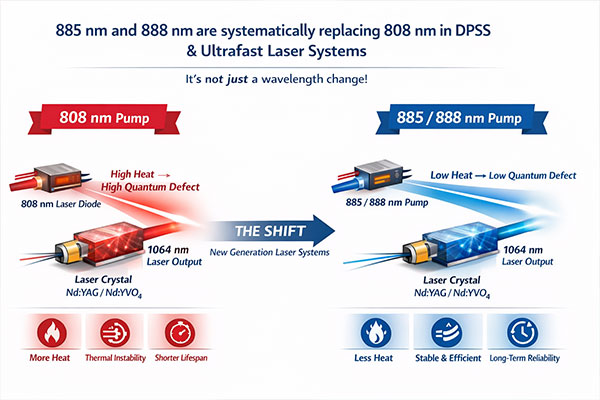
Engineers and researchers worldwide are now questioning the once-unshakable position of 808 nm.
This transition is closely tied to the evolution of laser diode pump source design, where wavelength selection directly impacts thermal behavior, efficacité, and long-term system stability.
For a complete technical overview, see our Laser Diode Pump Source Technology Hub.
Why Was 808 nm the Right Answer in the Past?
Back then, 808 nm wasn’t just usable—it was optimal.
808 nm matched the strongest absorption peak of Nd³⁺ crystals and was easy to produce with mature laser diode technology.
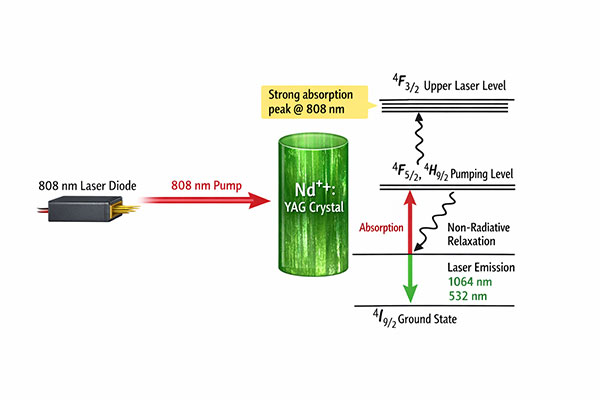
Strong Points of 808 nm Pumping
- sd:YAG and Nd:YVO₄ crystals absorb best at ~808 nm.
- Diodes were cost-effective, haute puissance, and easy to manufacture.
- Ideal for low-power, continuous wave DPSS systems.
- Supported early industrial laser applications with simple, reliable designs.
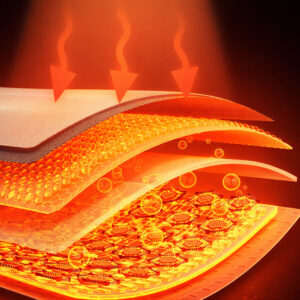
Where’s the Problem with 808 nm? It’s in the Heat.
Today’s laser applications demand more power, longer lifespan, and higher stability. This is where 808 nm starts to fall short.
The issue is not usability—it’s quantum defect and internal heat.
Pourquoi 808 nm Generates More Heat
| Paramètre | 808 nm Pump | 885/888 nm Pump |
|---|---|---|
| Absorption Efficiency1 | Haut | Modéré |
| Quantum Defect2 | Haut | Faible |
| Heat Load on Crystal | Haut | Inférieur |
| Long-Term Stability | Modéré | Haut |
- 808 → 1064 nm leads to big energy gap → more heat.
- Heat causes thermal lensing, polarization issues, unstable mode fields.
- Crystal becomes sensitive to cooling, limits power scaling.
What Makes 885 / 888 nm Better? Less Heat, Not Just More Efficiency
This is not a "stronger pump" story—it’s about smarter pumping.
885 nm and 888 nm pump at the quasi-zero-phonon line of Nd³⁺, minimizing quantum defect2.
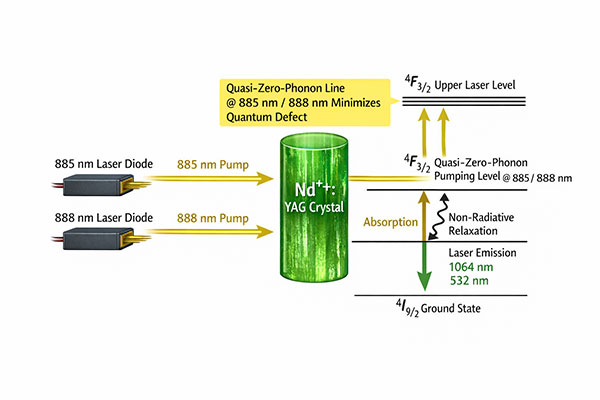
System-Level Impact of Reduced Quantum Defect
- 🔻 Lower heat in crystal
- 🔻 Less thermal lensing3
- 🔺 Better beam quality
- 🔺 Higher long-term stability
- 🔺 More precise mode and polarization control
These are the key metrics for:
- Precision micromachining
- High-stability marking systems
- Lasers ultrarapides (picosecond and femtosecond)
Why Is 888 nm4 Essential for Ultrafast Lasers?
Ultrafast systems expose 808 nm’s thermal problems even more severely.
Heat isn’t just a loss in efficiency—it can break the laser’s ability to work at all.
Ultrafast Laser Needs
- Locking cavity length must be ultra-stable
- Temperature drift ruins pulse timing
- Single hot spot disrupts mode-locking completely
That’s why:
- 888 nm4 is now the de facto standard for Yb/Nd-based ultrafast systems5
- 808 nm is considered obsolete in this field
- High-end femtosecond & picosecond lasers
- Industrial ultrafast tools
- Precision research systems
Why Not a Full Replacement? It’s a Layered Transition.
808 nm is not dead. It still has its place.
The shift to 885 / 888 nm is application-driven, not total.
Where 808 nm Still Works
- Low-power DPSS
- Cost-sensitive equipment
- Teaching labs and basic industry
- Systems that don’t require long-time stability
Where 885 / 888 nm Is Becoming Standard
- Medium to high power lasers
- Continuous use scenarios
- Precision and ultrafast applications
- OEM laser modules for professional use
The Real Shift: From Pumping Power to Thermal Management
This is not just a wavelength story.
The industry is evolving from “how much you pump” to “how well you manage heat.”
Design Priorities Are Changing
| Design Goal | 808 nm Era | 885/888 nm Era |
|---|---|---|
| Pump Power | Haut | Efficace & Cool |
| System Complexity | Tolerated | Minimized |
| Lifetime Stability | Optional | Mandatory |
| Mass Production Ready | Difficile | Engineered from start |
885 / 888 nm isn’t just a better number—it reflects a better system design logic.
Vivlaser 888 nm Pump Source: Designed for Stability and Performance
As laser systems evolve, so do the demands on pump source precision and reliability. Vivlaser propose une gamme de 888 nm narrow-spectrum pump modules tailored for high-end DPSS and ultrafast laser applications.
Vivlaser 888 nm diode modules6 deliver locked-wavelength performance with <1 nm spectral width, enabling superior thermal management and long-term operational stability.
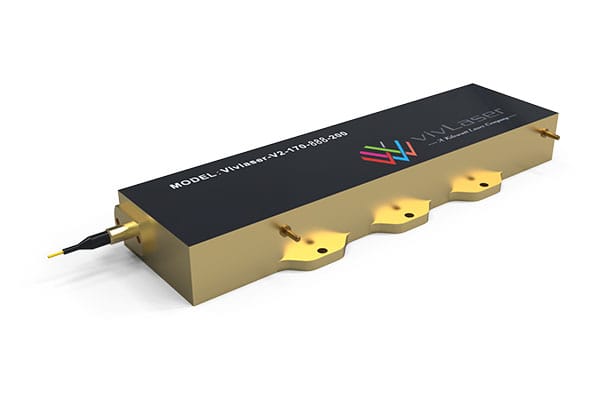
Core Specifications of Vivlaser 888 nm Pump Source
| Fonctionnalité | Specification |
|---|---|
| Center Wavelength | 888 nm (±0.5 nm) |
| Largeur spectrale (FWHM) | <1 nm |
| Output Power Options | 30W / 65W / 80W / 120W / 175W |
| Diamètre du noyau de la fibre | 200 µm / 400 µm |
| Numerical Aperture (QUE) | 0.22 |
| Fiabilité | Lifetime failure rate <1% |
| Personnalisation | Disponible |
Key Advantages
- 🔒 Wavelength-locked output ensures optimal absorption with Nd:YVO₄ crystals.
- ❄️ Efficient thermal design minimizes temperature drift.
- 🧩 Compact and customizable structure, ideal for integration into OEM systems.
- 🔁 Long-term consistency, perfect for 24/7 operation in high-precision environments.
Main Application Areas
- Picosecond / femtosecond ultrafast laser systems
- High-stability industrial DPSS lasers
- Precision micromachining and semiconductor processing
- Scientific research requiring long-term wavelength consistency7
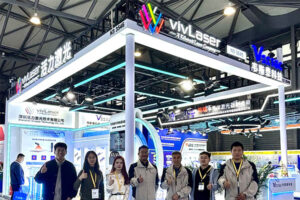
As a trusted supplier to industry leaders like Han’s Laser and Inno Laser, Vivlaser 888 nm pump modules are widely deployed in professional-grade systems across Europe, Asia, and North America.
Conclusion
885/888 nm represents not just more power, but more contrôle, consistency, et engineering maturity in solid-state laser systems.
-
Exploring Absorption Efficiency can provide insights into improving laser applications, essential for anyone in the field. ↩
-
Understanding Quantum Defect is crucial for optimizing laser performance and efficiency, making this resource invaluable for researchers. ↩ ↩
-
Exploring thermal lensing can help you grasp its impact on beam quality and stability in laser systems. ↩
-
Explore this link to understand the significance of 888 nm in enhancing laser performance and efficiency. ↩ ↩ ↩
-
Discover more about ultrafast systems and their applications in cutting-edge laser technology. ↩
-
Explore the advantages of 888 nm diode modules for enhanced performance in laser systems. ↩
-
Understand the significance of long-term wavelength consistency for reliable laser performance in various applications. ↩