High-precision UV lasers rely on one hidden hero — the pump source. Without it, no UV photon would ever be born.
A UV laser depends on a stable, wavelength-locked semiconductor pump source to achieve its power, stability, and narrow beam quality.
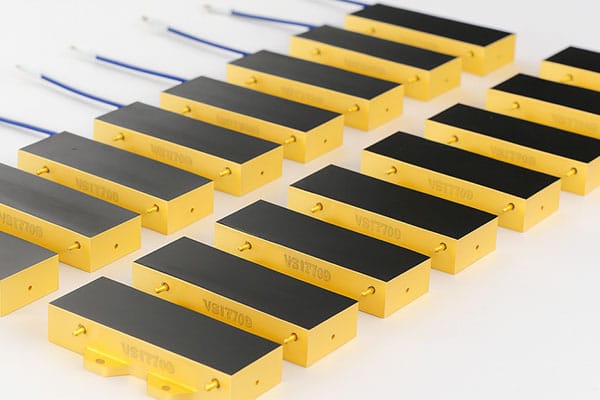
A pump source is the heart of a UV laser system. It determines output power, stability, and lifetime. Let’s explore how Vivlaser’s advanced 878 nm pump modules enable the next generation of DPSS UV lasers.
What Is a UV Laser and Why Does It Need a Pump Source?
UV lasers are solid-state lasers that generate ultraviolet light through nonlinear frequency conversion. They need a pump source to excite the gain medium and create population inversion.
A UV laser uses a semiconductor pump source1 to excite a crystal like Nd:YVO₄2, which then converts near-infrared light into UV through harmonic generation.

Dive deeper
A DPSS (diode-pumped solid-state) UV laser starts with a semiconductor laser diode that emits infrared light. This light pumps the crystal, usually Nd:YVO₄2, to produce a 1064 nm fundamental wavelength. The beam then passes through nonlinear crystals to create 532 nm (green) and finally 355 nm (UV) light through third-harmonic generation.
Without a precise and stable pump source, this entire process collapses. Even slight wavelength drift or power fluctuation can reduce harmonic conversion efficiency or shift the UV output wavelength. That’s why Vivlaser designs narrow-spectrum, wavelength-locked 878 nm pump sources that match the Nd:YVO₄2 absorption peak with ±0.5 nm accuracy, ensuring high absorption efficiency and consistent UV output.
The Role of Pump Sources in DPSS UV Lasers (355 nm)
UV lasers rely on DPSS architecture, where the pump source3 plays the critical role of providing the excitation energy for the laser crystal.
The pump source3 defines the efficiency, beam quality, and stability of a DPSS UV laser.

Dive deeper
A 355 nm UV laser typically uses a solid-state configuration of Nd:YVO₄ as the gain medium, pumped by a high-brightness diode around 878 nm. The laser first generates a 1064 nm IR beam, which is frequency-tripled to 355 nm.
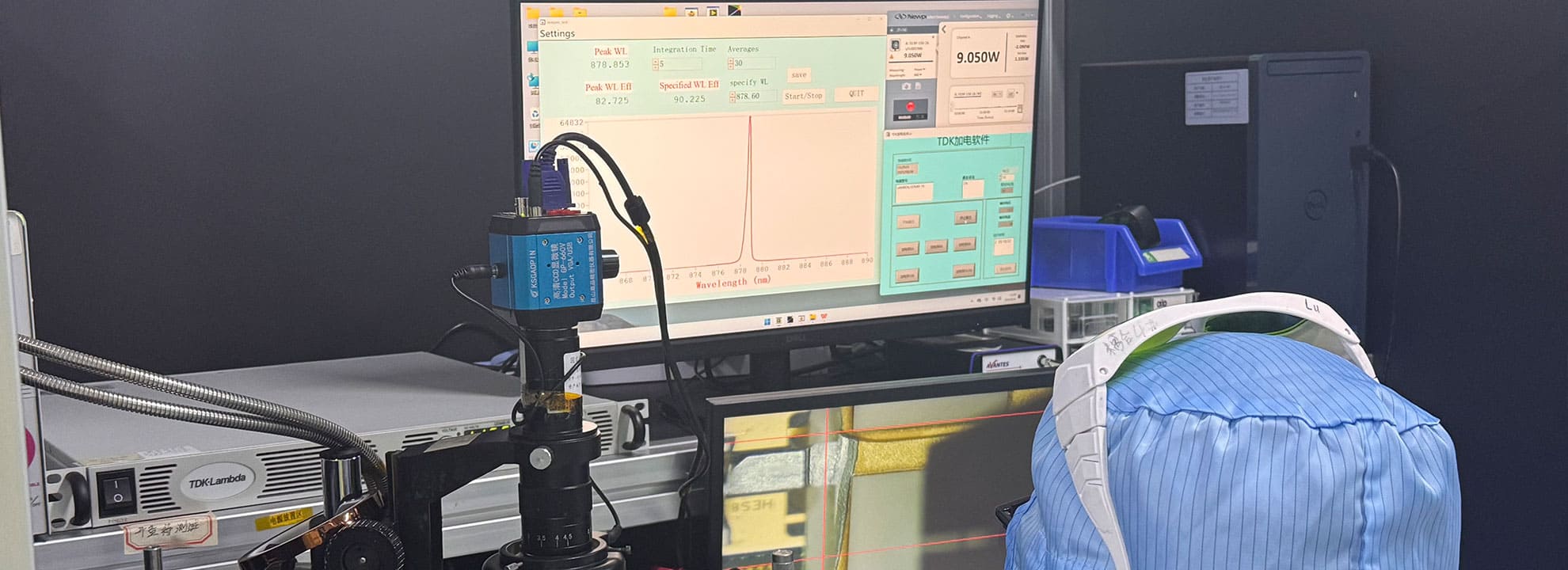
The pump diode must operate at a wavelength precisely matched to the crystal’s absorption peak to minimize thermal loading and improve optical conversion. Vivlaser’s 878.6 nm pump modules use VBG (Volume Bragg Grating) wavelength locking4 to ensure narrow linewidths (<1 nm), high reliability, and low thermal drift — key to stable UV generation in industrial and medical systems.
Inside the Pumping Chain: From 808/878 nm to 355 nm UV Output
Every DPSS UV laser follows a multi-step frequency conversion chain.
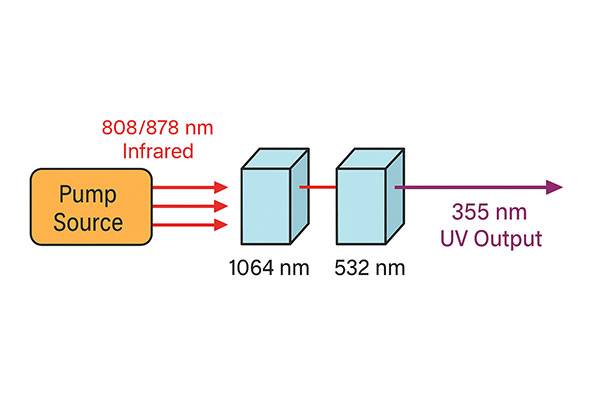
The pump source initiates a chain from 808/878 nm infrared light to 1064 nm, then to 532 nm, and finally 355 nm ultraviolet output5.
Dive deeper
The process can be summarized as:
878 nm (pump) → Nd:YVO₄ (gain medium, 1064 nm) → KTP/LBO (second harmonic, 532 nm) → BBO (third harmonic, 355 nm).
At each stage, efficiency depends heavily on the stability and spectral quality of the pump source. If the 878 nm wavelength shifts, absorption efficiency drops, leading to temperature rise, mode instability, and reduced harmonic output. Vivlaser’s pump sources maintain locked wavelength and uniform beam profiles to ensure consistent tripling performance across long operation cycles.
Key Pump Source Parameters That Determine UV Laser Performance
Not all pump diodes are equal — their parameters define laser system quality.
Power, beam quality, coupling efficiency, spectral width, and stability directly influence UV laser output.

Dive deeper
| Parameter | Description | Impact on UV Laser |
|---|---|---|
| Output Power6 | Total optical power emitted by pump source | Higher power improves UV output but increases heat load |
| Spectral Width | Width of emission spectrum (Vivlaser <1 nm) | Narrower width improves absorption and conversion |
| Wavelength Accuracy | Deviation from crystal absorption peak | ±0.5 nm ensures peak absorption |
| Coupling Efficiency7 | Fraction of power coupled into fiber or crystal | Higher coupling = lower losses |
| Stability | Power and wavelength fluctuation | Critical for maintaining harmonic conversion efficiency |
Vivlaser’s wavelength-locked 878 nm modules excel in all five aspects, providing steady output and long-term reliability tested beyond 16,000 hours without failure.
Why UV Lasers Require Higher Pump Source Stability Than IR/Green Lasers
UV output generation is highly nonlinear and sensitive to fluctuation.
UV lasers amplify every small instability from the pump source due to multi-stage frequency conversion.
Dive deeper
In IR or green lasers, small thermal drifts have limited effect. But in UV systems, each frequency-doubling or -tripling step multiplies error. A 0.1 nm pump shift can alter UV output wavelength or reduce harmonic conversion efficiency by more than 10%.
Vivlaser’s narrow-spectrum, thermally stabilized modules solve this by maintaining wavelength lock within ±1 nm across 25–35 °C and delivering power stability better than 1%. This ensures consistent UV output even under long industrial operating cycles.
Thermal Management: The Real Determinant of Pump Source Lifetime
Thermal stability defines performance, reliability, and service life.
Effective thermal management prevents degradation, spectral drift, and premature diode failure.
Dive deeper
Semiconductor pump diodes generate significant heat during operation. If not dissipated efficiently, thermal stress can shift the emission wavelength and damage internal structures.
Vivlaser integrates high-efficiency cooling designs, thermal stress management, and real-time temperature feedback into each pump module. These designs allow continuous operation above 10,000 hours with minimal drift. Their advanced TEC-controlled housing maintains precise thermal balance, ensuring both wavelength stability and long diode lifespan.
808 nm vs. 878 nm Pump Sources: Which One Is Better for UV Lasers?
The battle between 808 nm and 878 nm pump diodes defines the next generation of UV lasers.
878 nm pump sources8 offer higher efficiency, lower heat load, and better UV conversion than traditional 808 nm sources.

Dive deeper
| Comparison | 808 nm Pump | 878 nm Pump (Vivlaser) |
|---|---|---|
| Absorption Medium | Nd:YAG | Nd:YVO₄ |
| Quantum Defect | High | Lower |
| Thermal Load | Higher | Reduced |
| Beam Quality | Moderate | Excellent |
| Conversion Efficiency | 3–5% lower | Higher by 10–15% |
| Lifetime | Shorter | Extended due to better heat management |
Vivlaser’s 878.6 nm narrow-spectrum modules replace older 808 nm pump9s used in UV systems. By lowering quantum defect and thermal lensing, they improve harmonic conversion efficiency, beam quality, and system stability — all crucial for high-precision UV machining.
Fiber-Coupled Pump Modules vs. Free-Space Pumping in UV Laser Systems
Choosing between fiber-coupled and free-space designs affects integration and performance.
Fiber-coupled pump sources10 offer better alignment stability and thermal isolation for compact UV laser systems.
Dive deeper
Free-space pumping provides direct coupling into the crystal but requires precise alignment and suffers from mechanical drift. Fiber-coupled modules, like Vivlaser’s 200 µm/0.22 NA designs, allow flexible routing, consistent beam quality, and improved mechanical stability.
For industrial UV lasers, fiber coupling reduces maintenance and improves thermal management, since the heat source (diode) can be located away from the laser head. Vivlaser’s high-power fiber-coupled solutions combine these advantages with wavelength-locked emission and long lifespan.
Common Pump-Source-Related Failures in UV Lasers (And How to Prevent Them)
Many UV laser failures originate from the pump source itself.
Overheating, spectral drift, and fiber coupling loss are the most common failure causes.
Dive deeper
| Failure Type | Cause | Prevention |
|---|---|---|
| Overheating | Poor cooling or high ambient temp | Use efficient TEC + copper heat sinks |
| Spectral Drift | Temperature instability | Apply VBG locking and feedback control |
| Coupling Loss | Fiber misalignment or contamination | Maintain clean fiber connectors |
| Mode Jumping | Pump current fluctuation | Use constant-current drive and feedback |
| Degradation | Aging of diode facet | Regular monitoring and low-stress operation |
Vivlaser’s RMA data show that more than 70% of UV laser issues relate to pump thermal or coupling instability. The company’s advanced testing, quality control, and lifetime evaluation protocols ensure reliability in demanding UV applications.
How to Select the Right Pump Source for Your UV Laser Design
Selecting the right pump source is critical for performance, stability, and cost efficiency.
Match your laser crystal, power level, and thermal design with a wavelength-locked 878 nm pump source for best results.
Dive deeper
When designing a UV laser system, engineers should prioritize:
- Wavelength Match: Choose a pump wavelength aligned with Nd:YVO₄ absorption (878.6 nm ± 0.5 nm).
- Spectral Stability: Ensure VBG locking and narrow linewidth.
- Thermal Design: Integrate efficient TEC and heat spreaders.
- Coupling Configuration: Fiber-coupled for compact systems; free-space for large-format designs.
- Reliability Data: Verify long-term tests (>15,000 h).
Vivlaser’s 878 nm series meets all these criteria with power options from 25 W to 175 W, available in 200 µm/400 µm fiber-coupled formats, supporting industrial and medical UV laser integrators globally.
Conclusion
UV laser performance begins and ends with the pump source. Vivlaser’s 878 nm wavelength-locked pump modules deliver the precision, stability, and efficiency that next-generation UV laser systems demand.
-
Explore this link to understand the critical role of semiconductor pump sources in enhancing UV laser performance. ↩
-
Learn about Nd:YVO₄’s significance in UV lasers and how it contributes to efficient light conversion. ↩ ↩ ↩
-
Understanding the pump source’s role can enhance your knowledge of laser efficiency and stability. ↩ ↩
-
Exploring VBG technology can provide insights into achieving high reliability and precision in laser applications. ↩
-
Exploring the process of achieving 355 nm output can enhance your knowledge of laser technology and its applications. ↩
-
Understanding Output Power is crucial for optimizing UV laser systems and enhancing their efficiency. ↩
-
Exploring Coupling Efficiency can reveal ways to minimize losses and improve overall laser performance. ↩
-
Explore the benefits of 878 nm pump sources, including efficiency and heat management, to enhance your UV laser applications. ↩
-
Learn about the limitations of 808 nm pumps and why transitioning to newer technologies can improve your UV laser performance. ↩
-
Explore this link to understand how fiber-coupled pump sources enhance stability and performance in UV laser systems. ↩