Modern ophthalmology1 would be unimaginable without lasers. Once a science-fiction concept, lasers are now a cornerstone of eye surgery — enabling treatments that are minimally invasive, highly precise, and remarkably effective. From reshaping the cornea to sealing leaking retinal blood vessels, lasers have transformed the way we treat eye diseases and restore vision.
In this article, we’ll explore how lasers work in eye surgery, the most common laser types, and their applications across different ophthalmic procedures.
Why Use Lasers in Eye Surgery?
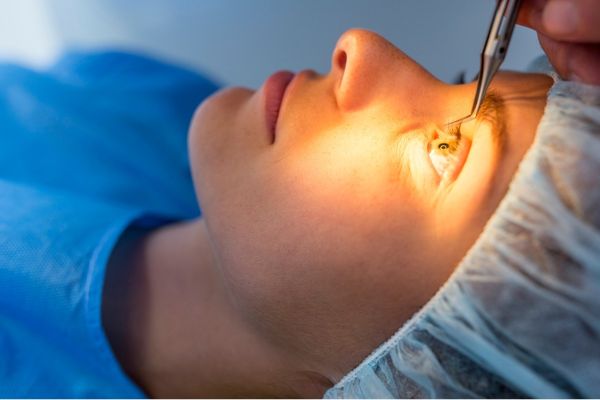
Lasers (Light Amplification by Stimulated Emission of Radiation) generate highly focused, coherent beams of light that can cut, vaporize, or coagulate tissue with micrometer-level precision.
Their main advantages in eye surgery include:
-
✅ Minimally invasive: Most procedures require no incisions, reducing infection risk.
-
✅ High precision: Lasers can target microscopic areas without damaging surrounding tissue.
-
✅ Faster recovery: Less trauma means shorter healing times and better outcomes.
-
✅ Versatility: Different wavelengths and pulse types allow treatment of a wide range of eye conditions.
1. Vision Correction: Reshaping the Cornea
Excimer Laser2 (193 nm, ultraviolet)
One of the most common uses of laser technology in ophthalmology is refractive surgery — procedures that correct myopia, hyperopia, and astigmatism by reshaping the cornea.
-
How it works: The excimer laser removes microscopic layers of corneal tissue, altering its curvature to correctly focus light onto the retina.
-
Procedures: LASIK, PRK, LASEK.
-
Advantages: “Cold ablation” process produces no heat damage, allowing extremely precise reshaping.
📍 Example:
Excimer lasers can remove 0.25 microns of tissue with each pulse, enabling surgeons to correct vision with incredible accuracy.
2. Corneal Cutting and SMILE Surgery
Femtosecond Laser (1030–1053 nm, near-infrared)
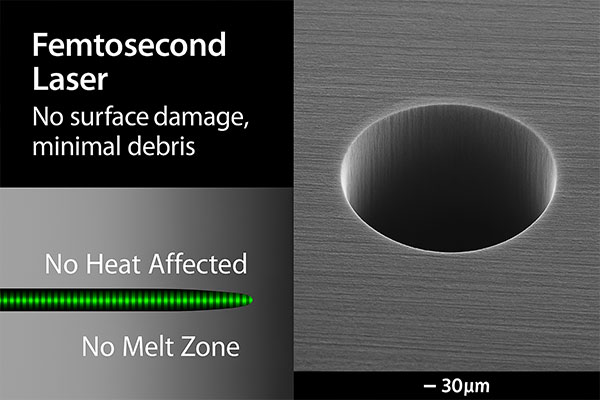
Femtosecond lasers emit ultrashort pulses — lasting only one quadrillionth of a second — that can cut tissue at a microscopic level without heat or mechanical damage.
-
How it works: The laser creates tiny bubbles that separate tissue layers, allowing surgeons to form corneal flaps or extract lenticules.
-
Procedures: SMILE (Small Incision Lenticule Extraction), flap creation in LASIK3, lens fragmentation in cataract surgery.
-
Advantages: Unparalleled precision, no thermal damage, rapid recovery.
📍 Example:
Femtosecond lasers allow surgeons to sculpt tissue at a cellular level, enabling minimally invasive refractive procedures like SMILE.
3. Posterior Capsulotomy4 and Iris Surgery
Nd:YAG Laser (1064 nm, infrared)

After cataract surgery, some patients develop a cloudy posterior capsule — a condition known as posterior capsule opacification (PCO)5. Nd:YAG lasers offer a quick, painless solution.
-
How it works: A focused burst of laser energy creates a small opening in the capsule, restoring clear vision.
-
Other uses: Laser iridotomy for glaucoma.
-
Advantages: Non-contact procedure, strong penetration, immediate vision improvement.
📍 Example:
A YAG capsulotomy can restore vision in minutes and requires no surgical incision.
4. Retinal Treatments6 and Vascular Disorders
Argon Laser (488 nm blue / 514 nm green)7(https://www.sciencedirect.com/topics/biochemistry-genetics-and-molecular-biology/argon-laser)
Retinal diseases such as diabetic retinopathy, retinal tears, and vascular malformations often require precise sealing or coagulation — tasks perfec t for argon lasers.
-
How it works: Light energy is absorbed by blood and pigment, producing controlled coagulation that seals leaks, halts bleeding, or secures detached retina.
-
Advantages: Excellent absorption, precise targeting, effective long-term stabilization.
📍 Example:
Argon laser photocoagulation remains the gold standard for preventing vision loss in diabetic retinopathy.
5. Glaucoma and Deep Tissue Treatments
Diode Laser (810 nm / 940 nm, near-infrared)7
Diode lasers are compact, versatile, and widely used for glaucoma treatment and deep retinal photocoagulation.
-
How it works: The laser reduces intraocular pressure by improving aqueous humor drainage or by destroying overactive ciliary tissue.
-
Advantages: High absorption, deep penetration, smaller and more portable equipment.
📍 Example:
Diode lasers offer a safe and effective option for patients with advanced glaucoma or neovascular complications.
Quick Reference: Laser Types and Their Ophthalmic Uses
| Laser Type | Wavelength | Main Applications | Key Features |
|---|---|---|---|
| Excimer | 193 nm | LASIK, PRK | Cold ablation, precise corneal reshaping |
| Femtosecond | 1030–1053 nm | SMILE, corneal flaps, cataract | Ultrashort pulses, no thermal damage |
| Nd:YAG | 1064 nm | Posterior capsulotomy, iridotomy | Non-contact, high penetration |
| Argon | 488 / 514 nm | Retinal photocoagulation, vascular sealing | Strong pigment absorption |
| Diode | 810 / 940 nm | Glaucoma, deep retinal treatment | Compact, powerful, deep penetration |
Conclusion: Precision Light for Delicate Vision
The eye is one of the most delicate organs in the human body — and lasers, with their unmatched precision and control, are the ideal tools for repairing it. Whether correcting refractive errors, treating retinal disease, or managing glaucoma, laser surgery offers patients faster recovery, improved safety, and better long-term outcomes.
As laser technology continues to advance — with innovations like adaptive optics, ultrafast femtosecond pulses, and AI-guided targeting — the future of ophthalmology looks brighter than ever. Quite literally, it’s light that helps us see the world more clearly.
About Vivlaser — Your Reliable Partner for Semiconductor Laser Solutions
At Vivlaser, we specialize in the design and manufacturing of high-performance semiconductor laser modules for medical, aesthetic, and industrial applications. Our products feature stable output, compact design, and customizable wavelengths — making them ideal for integration into advanced ophthalmic laser systems.
Whether you are building a new medical device, upgrading an existing platform, or exploring innovative laser applications, Vivlaser is here to support you with reliable technology and professional expertise.
📩 If you’re looking for a trusted semiconductor laser supplier for ophthalmic or other medical devices, don’t hesitate to contact us — we’re ready to help bring your laser solutions to life.
-
Understand what ophthalmology encompasses and the conditions it treats. ↩
-
Learn the definition, working principle, and common applications of excimer lasers. ↩
-
Understand what LASIK is, how the procedure works, and why excimer lasers are used in it. ↩
-
Explore the role of capsulotomy in cataract treatment and why precision laser tools are essential. ↩
-
Find out why PCO is the most common complication after cataract surgery and how it’s effectively treated. ↩
-
Learn how argon lasers are used in ophthalmology, especially for treating retinal tears and diabetic eye disease. ↩
-
See how diode lasers offer compact, efficient solutions for medical, dental, and industrial laser applications. ↩ ↩