KEY TAKEAWAYS
Both 405 nm lasers and UV LEDs are widely used in resin 3D printing because they match the absorption peak of common photoinitiators.
Laser systems provide higher beam quality, which enables finer resolution and better focus control.
UV LED systems are cheaper and simpler, which makes them popular in consumer and desktop printers.
The choice between laser and LED depends on required resolution, system cost, and production scale.
For precision industrial printing, lasers often deliver better control, while LEDs offer better cost efficiency.
Resin 3D printing depends on precise light curing, but the type of light source strongly affects accuracy, speed, and system cost. Many designers underestimate this choice.
In practice, both 405 nm lasers and UV LEDs can cure photopolymer resins effectively. However, lasers provide higher beam quality and resolution, while LEDs offer lower cost and simpler system design.
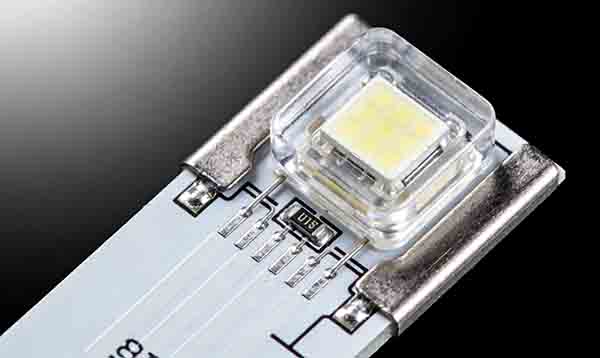
To understand why manufacturers choose different light sources, it is necessary to compare beam physics, optical system design1, and manufacturing economics.
Why Do Resin Printers Use 405 nm Light Sources?
Resin printers require a wavelength that activates photoinitiators efficiently. Using the wrong wavelength reduces curing speed and print reliability.
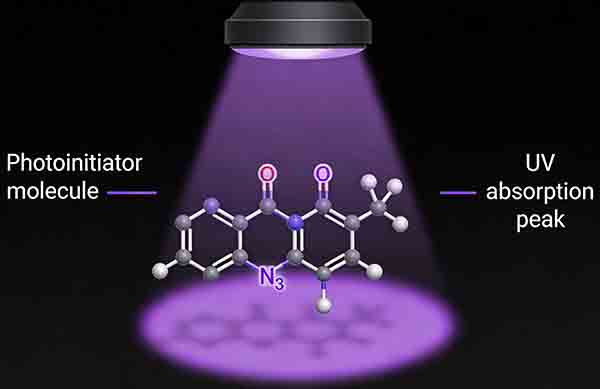
Most modern resin printers use 405 nm light sources because common photoinitiators absorb strongly in the violet region, enabling efficient polymerization.
Deep Explanation
Photopolymer chemistry defines the wavelength
Resin 3D printing relies on photopolymerization2. The liquid resin contains monomers and a photoinitiator. When exposed to light of the correct wavelength, the photoinitiator absorbs photons and generates reactive radicals. These radicals start a chain reaction that converts liquid resin into solid polymer.
For this reaction to occur efficiently, the wavelength of the light source must match the absorption spectrum of the photoinitiator3. Most modern photoinitiators used in SLA, DLP, and LCD resin printers absorb strongly in the violet region, typically around 380–420 nm. Because of this, 405 nm became a practical industry standard.
The balance between chemistry and electronics
Another reason 405 nm dominates resin printing is the availability of semiconductor light sources4. Diode lasers and LEDs at this wavelength are mature technologies due to large-scale production in optical storage systems such as Blu-ray devices. This manufacturing ecosystem lowered the cost of violet light sources dramatically.
From an engineering perspective, 405 nm represents a balance between chemical efficiency and hardware practicality. It provides strong absorption for photoinitiators while allowing compact and affordable optical systems.
Why other wavelengths are rarely used
Shorter UV wavelengths such as 355 nm can also cure resin effectively, but they require more expensive laser sources and complex optical systems. Longer wavelengths such as green or red light do not interact strongly with standard photoinitiators, which makes curing inefficient.
The table below summarizes the general behavior.
| Wavelength | Resin curing efficiency | System practicality |
| 355 nm UV | Very strong curing | Higher system cost |
| 405 nm violet | Excellent curing | Mature diode technology |
| 520 nm green | Weak curing | Limited photoinitiator absorption |
| 1064 nm IR | Very weak curing | Not suitable for photopolymerization |
This combination of photochemistry and device availability explains why both lasers and LEDs in resin printers commonly operate at 405 nm.
Engineering Check
“405 nm light is widely used in resin printing because most photoinitiators absorb strongly in this wavelength region.”
This is correct because the absorption spectra of common photoinitiators overlap strongly with violet wavelengths.
“Any visible wavelength can cure photopolymer resin with the same efficiency.”
This is false because photoinitiators require specific photon energies to trigger polymerization.
What Are the Main Differences Between Laser and LED Light Sources?
Many engineers assume that lasers and LEDs behave similarly in resin printing systems. In reality, their optical properties are very different.
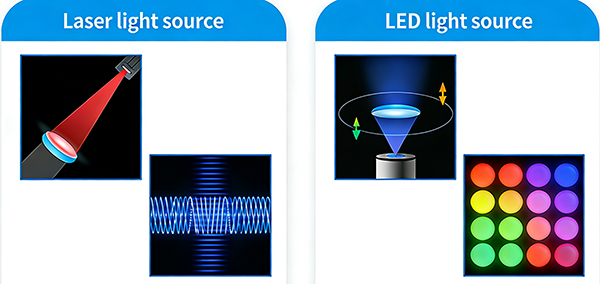
Lasers provide coherent, tightly focused beams, while LEDs produce broader and less directional light. This difference directly affects resolution and optical system design.
Deep Explanation
Beam quality and optical focus
The most important difference between lasers and LEDs is beam quality. A laser emits coherent and highly directional light5. This allows the optical system to focus the beam to a very small spot size. In resin printing, smaller spot sizes translate into higher printing resolution and finer feature details.
LEDs emit incoherent light with a wider angular distribution. Even with optical lenses or projection systems, the light cannot be focused as tightly as a laser beam. This limits the achievable feature resolution.
Scanning versus projection systems
Laser-based printers often use galvanometer scanners6 to move a focused beam across the resin surface. This approach is common in stereolithography systems. Because the beam is very small, the printer can draw extremely precise features layer by layer.
LED-based printers usually rely on projection or LCD masking systems. Instead of scanning a beam, they illuminate an entire layer at once. This can increase printing speed but usually reduces the maximum resolution compared with laser systems.
System complexity and cost
Laser systems typically require scanning optics, beam control electronics7, and precise alignment. This increases system complexity and cost. However, it also allows flexible control over the exposure pattern.
LED systems are simpler. They can illuminate a digital mask or LCD panel8, which then defines the printed pattern. Because the optical system is simpler and LED sources are cheaper, many consumer resin printers use this approach.
The main differences can be summarized as follows.
| Technology | Laser | LED |
| Beam quality | High | Lower |
| Cost | Medium | Low |
| Resolution | High | Medium |
This comparison explains why high-end industrial printers often favor lasers, while desktop printers commonly rely on LED systems.
Engineering Check
“Laser sources provide higher beam quality than LEDs, which allows tighter focusing and higher printing resolution.”
Laser beams are coherent and directional, enabling precise optical focusing in scanning systems.
“LED light sources can achieve the same focus quality as laser beams in resin printing systems.”
LED emission is spatially broad and incoherent, which limits the minimum achievable spot size.
Which Technology Is Better for Resin 3D Printing?
Choosing the wrong light source can create unnecessary system cost or limit printing performance. The correct choice depends on the intended application.
Laser-based resin printers9 typically deliver higher resolution and precision, while LED systems provide lower cost and simpler design.
Deep Explanation
Performance considerations
Laser systems excel when the application requires fine details and precise feature control. Because the beam can be focused to a small spot and scanned accurately, the printer can achieve high-resolution structures. This is especially useful in industrial prototyping10, dental models, and precision micro-components.
LED systems11 prioritize simplicity and affordability. By illuminating an entire layer simultaneously, LED printers can produce parts quickly without complex scanning hardware. For consumer printers or low-cost manufacturing environments, this approach offers excellent value.
Cost and scalability
Another important factor is scalability. LED arrays are relatively inexpensive and easy to scale across larger printing areas. This allows manufacturers to build wide printing platforms without dramatically increasing system cost.
Laser systems scale differently. Increasing build area often requires larger scanning optics and more precise control systems. While this increases cost, it also maintains high optical precision.
Practical decision logic
For engineers selecting a light source, the decision often follows a simple logic.
| Priority | Recommended technology |
| Highest resolution | Laser |
| Lowest system cost | LED |
| Precision industrial printing | Laser |
| Consumer or desktop printers | LED |
This is why the resin 3D printing market contains both technologies. Each one solves a different engineering problem.
Engineering Check
“Laser-based resin printers generally achieve higher resolution than LED-based printers.”
Laser scanning systems can focus the beam into very small spots, enabling fine feature printing.
“LED resin printers always produce higher quality parts than laser-based printers.”
Part quality depends on optical resolution, exposure control, and resin properties, not LED usage alone.
Conclusion
Both 405 nm lasers and UV LEDs are effective light sources for resin 3D printing, but lasers favor precision and resolution while LEDs offer lower cost and simpler system architecture12.
My Insight
From an engineering point of view, the choice between a 405 nm laser and a UV LED is really a trade-off between optical precision and system simplicity. Lasers provide a tightly focused beam, which allows higher resolution and better control of small features. That is why laser-based SLA systems13 are often used when accuracy is critical.
UV LED systems, however, simplify the hardware architecture. They illuminate an entire layer through an LCD or projection system, which significantly reduces cost and mechanical complexity. For most desktop resin printers, this design offers a better balance between performance and price.
In other words, the decision is rarely about wavelength, because both systems usually operate around 405 nm. The real engineering decision is about how the light is delivered to the resin: a focused scanning beam or a projected exposure pattern.
- Optical system design determines light distribution and curing efficiency, making it essential for optimizing print quality and reducing production costs in additive manufacturing. ↩︎
- Understanding photopolymerization is essential to grasp the fundamental chemical process behind resin 3D printing and why specific wavelengths are required. ↩︎
- The absorption spectrum determines which wavelengths effectively trigger polymerization, making it crucial for selecting the right light source for resin printers. ↩︎
- Semiconductor light sources offer practical advantages in cost, size, and reliability, explaining why 405 nm became the industry standard. ↩︎
- Understanding the physics of coherent light helps engineers design more precise optical systems for high-resolution applications. ↩︎
- Learn how galvanometer scanning technology enables precise beam control and faster printing speeds in industrial applications. ↩︎
- Explore the electronic systems that enable accurate laser positioning and exposure control for high-quality prints. ↩︎
- Discover the mechanics behind mask-based projection systems that make desktop resin printing affordable and accessible. ↩︎
- Understanding laser technology’s capabilities helps determine if it’s suitable for your precision manufacturing needs, especially for industrial prototyping and dental models. ↩︎
- Learning about industrial prototyping solutions helps manufacturers choose the right technology for precision, durability, and production efficiency. ↩︎
- Exploring LED systems reveals their advantages in affordability and simplicity, making them ideal for consumer and desktop printing applications. ↩︎
- Exploring cost-effective and simpler system architectures can help you make informed decisions when selecting or building a resin 3D printer that fits your budget and technical requirements. ↩︎
- Understanding laser-based SLA systems will help you appreciate their superior accuracy for applications requiring fine details and tight tolerances in professional manufacturing. ↩︎