Laser hair removal technology relies heavily on wavelength selection.
Different wavelengths interact with skin tissue in different ways, influencing penetration depth, melanin absorption, treatment efficiency, and safety across various skin types.

Among the most widely used wavelengths in modern hair removal systems are:
-
755 nm (Alexandrite lasers)
-
808 nm (Diode lasers)
-
1064 nm (Nd:YAG lasers)
Each wavelength presents unique advantages and limitations from both biological and engineering perspectives.
Understanding these trade-offs helps explain why different laser platforms are used in clinical and consumer aesthetic devices.
The Role of Chromophore Absorption
Laser hair removal is based on the principle of selective photothermal interaction1, where light energy is absorbed by melanin in the hair follicle.
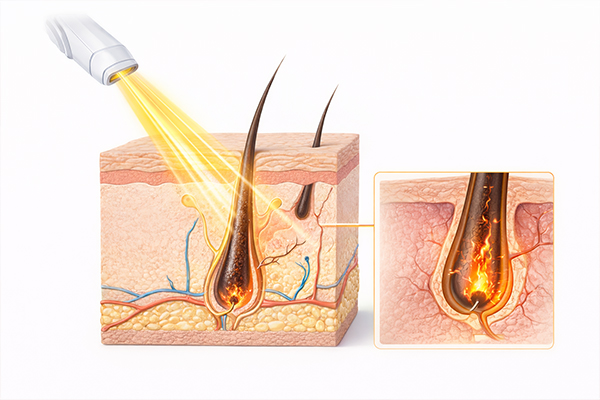
Once absorbed, the energy converts into heat, damaging the follicular structure responsible for hair growth.
However, melanin absorption varies significantly with wavelength2.
Shorter wavelengths interact more strongly with melanin, while longer wavelengths penetrate deeper into skin tissue with reduced absorption.
This balance between absorption and penetration determines treatment performance.
Comparison of Common Hair Removal Wavelengths
| Wavelength | Laser Type | Melanin Absorption | Penetration Depth | Typical Use |
|---|---|---|---|---|
| 755 nm | Alexandrite | High | Moderate | Light skin |
| 808 nm | Diode | Balanced | Moderate–deep | Most skin types |
| 1064 nm | Nd:YAG | Low | Deep | Darker skin |
This comparison illustrates why no single wavelength is universally optimal for every situation.
Instead, device manufacturers must evaluate several engineering trade-offs.
755nm Lasers: Strong Absorption but Limited Versatility
The 755 nm Alexandrite laser3 is known for its strong melanin absorption.
Higher absorption allows efficient heating of hair follicles, which can result in effective treatment for individuals with light skin and dark hair4.
However, this strong absorption also introduces challenges.
Because epidermal melanin absorbs energy as well, the risk of surface heating and pigmentation changes increases for darker skin types.
As a result, Alexandrite lasers are typically used in controlled clinical environments rather than portable consumer systems.
808nm Diode Lasers: A Balanced Engineering Solution
The 808 nm wavelength5 provides a balance between melanin absorption and tissue penetration.
Compared with shorter wavelengths, 808 nm reduces excessive epidermal absorption while still delivering sufficient energy to the follicle.
This balance allows effective treatment across a broader range of skin types.
From an engineering perspective, 808 nm diode lasers offer additional advantages:
-
high electrical-to-optical efficiency
-
compact semiconductor architecture
-
scalable output power
-
compatibility with handheld device designs
For these reasons, diode laser platforms operating around 808 nm have become the most widely used architecture in modern hair removal systems
1064nm Nd:YAG Lasers: Deep Penetration for Dark Skin
The 1064 nm Nd:YAG laser
6penetrates deeper into skin tissue due to reduced scattering and lower melanin absorption.
This makes it particularly suitable for treating darker skin types, where minimizing epidermal heating is critical.
However, lower melanin absorption also means that more energy may be required to achieve effective follicle heating.
In practice, Nd:YAG systems are often used in clinical settings where higher energy levels and specialized cooling systems can be employed.
System Design Considerations
Beyond biological absorption characteristics, several engineering factors influence wavelength selection.
Thermal Management
Higher power densities require effective cooling strategies to maintain laser stability and device longevity.
Device Size and Integration
Semiconductor diode lasers used at 808 nm can be packaged into compact modules suitable for portable systems.
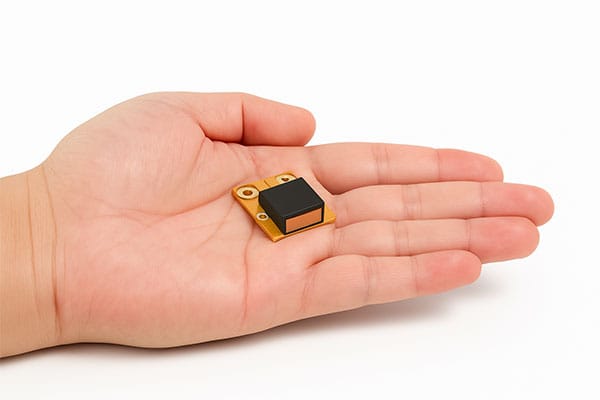
In contrast, solid-state platforms such as Alexandrite or Nd:YAG lasers typically require larger optical assemblies.
Energy Delivery Efficiency
Single-wavelength diode lasers provide more concentrated energy delivery compared with broadband technologies such as IPL7, improving treatment predictability.
Why Many Modern Devices Favor 808nm
Although each wavelength has specific advantages, **808 nm diode lasers [^8]represent one of the most practical solutions for many device architectures**.
They offer a balanced combination of:
-
effective melanin targeting
-
sufficient penetration depth
-
compact semiconductor design
-
scalable power output
Advances in semiconductor laser engineering have also enabled smaller and more efficient laser modules.
Companies specializing in compact diode laser technologies, such as Vivlaser, support device manufacturers by providing integration-friendly laser modules designed for modern aesthetic systems.
Industry Insight:
After working with hair-removal laser platforms for many years, one reality that is rarely mentioned in marketing materials is that wavelength alone does not determine treatment performance.
In theory, 755 nm offers strong melanin absorption, 808 nm provides balanced penetration, and 1064 nm improves safety for darker skin.
But in actual devices, the decisive factor is often laser module engineering—including diode quality, optical coupling efficiency, thermal management, and pulse stability. Two machines using the same wavelength can deliver dramatically different results if the underlying laser source is poorly designed. This is why many experienced device manufacturers quietly prioritize stable high-power diode modules (especially around 808 nm) rather than relying purely on theoretical wavelength advantages.
In practice, the real competitive edge in modern hair-removal systems lies less in the wavelength itself and more in how well the laser source is engineered and integrated into the system.
-
Learn the core treatment principle ↩
-
Understand why melanin is the target ↩
-
Understand high melanin absorption mechanism ↩
-
Learn how contrast improves effectiveness ↩
-
Learn why 808 nm balances absorption and penetration ↩
-
Understand deep penetration mechanism ↩
-
Compare wavelength precision and efficiency ↩