Key Takeaways
Lasers engrave inside glass using nonlinear absorption that occurs only at high energy density
The process creates localized micro-fracture point without affecting surrounding material
Energy is tightly focused, so only the focal region experiences breakdown
Proper pulse control prevents cracks from propagating to the surface
System stability and focusing accuracy are critical for safe internal engraving
Glass is fragile and prone to cracking. Traditional machining easily damages it. This limits precision processing. Laser engraving1 solves this by modifying only the internal structure without stressing the surface.
Lasers can engrave inside glass because energy is concentrated at a focal point, triggering nonlinear absorption2 and localized micro-fractures3 without affecting the surrounding material.
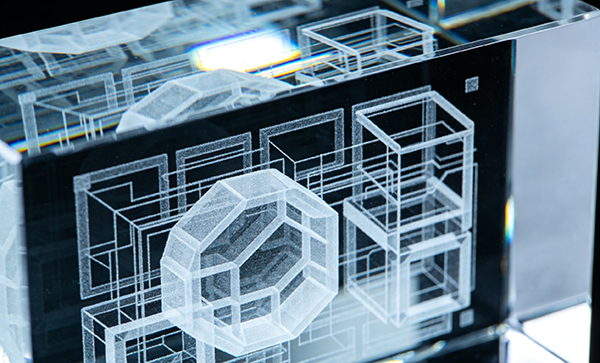
To understand why glass does not break, you need to look at how energy interacts with the material at a microscopic level.
What Is Nonlinear Absorption in Laser Engraving?
Glass is transparent under normal conditions. It should not absorb laser energy. So how does engraving happen inside it?
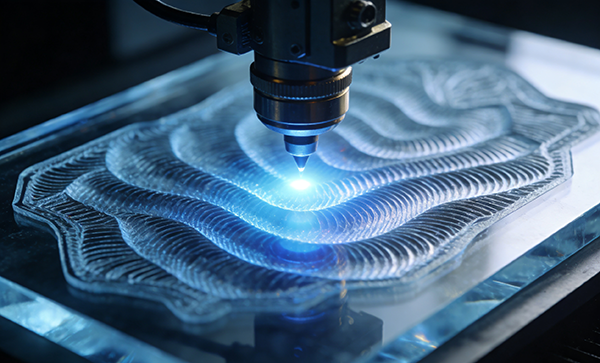
Nonlinear absorption occurs when laser intensity is high enough to force the material to absorb energy only at the focal point, enabling internal modification.
Deep Explanation
Linear vs Nonlinear Absorption
Under low energy conditions, glass behaves predictably:
- Light passes through
- No energy is absorbed
- No structural change occurs
This is called linear absorption.
However, when a high-intensity pulsed laser4 is used, the situation changes.
Nonlinear Absorption Mechanisms
At the focal point, energy density becomes extremely high. This triggers:
- Multiphoton absorption
- Avalanche ionization5
- Free electron generation
These effects only occur when intensity exceeds a threshold.
Why It Is Localized
The key advantage is localization:
- Outside focal region → no absorption
- At focal point → strong absorption
This creates a highly confined interaction zone.
Engineering Implications
| Factor | Effect |
| Pulse energy | Determines absorption threshold |
| Beam quality | Affects focus sharpness |
| Wavelength | Influences transmission |
| Pulse duration | Controls interaction time |
High-quality semiconductor laser systems provide stable output and precise energy control, ensuring consistent nonlinear interaction inside the material.
Practical Insight
Nonlinear absorption allows energy to bypass the surface and act only inside the material. This is the fundamental reason internal engraving is possible.
Engineering Check
“Nonlinear absorption allows transparent materials to absorb laser energy only at high intensity regions.”
The absorption occurs only when the energy density exceeds a threshold at the focal point.
“Glass absorbs laser energy uniformly along the beam path during subsurface engraving.”
Absorption is highly localized at the focal point, not along the entire path.
Why Does Localized Micro-Fracture Not Break the Glass?
Cracks usually spread in glass and cause failure. This makes internal engraving seem risky. But controlled laser processes6 avoid this.
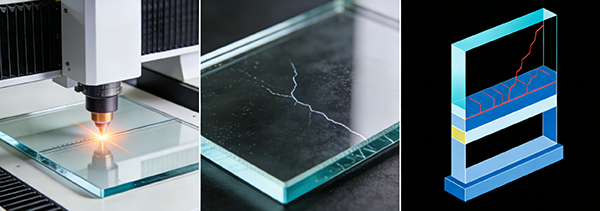
The laser creates extremely small, localized micro-fracture7 points that do not propagate, so the overall structure remains intact.
Deep Explanation
Micro-Fracture Formation
When optical breakdown occurs:
- Plasma forms at the focal point8
- Rapid expansion generates pressure
- A micro-fracture is created
This fracture is very small and contained.
Why Cracks Do Not Propagate
Several factors prevent damage spreading:
- Small micro-fracture size
- Rapid energy dissipation
- No continuous stress field
- Controlled spacing between micro-points
Each micro-point is isolated.
Stress Control Mechanism
| Factor | Role |
| Pulse energy | Limits fracture size |
| Micro-point spacing | Prevents overlap stress |
| Material quality | Affects crack resistance |
Role of Pulse Duration
Short pulses (nanosecond or picosecond):
- Minimize heat diffusion
- Reduce thermal stress
- Limit damage zone
This prevents large cracks.
Engineering Insight
The process is not uncontrolled cracking. It is controlled micro-damage. Each micro-point is engineered to stay within safe stress limits.
Practical Implications
- No visible external damage
- No structural failure
- High repeatability
This is why internal engraving is reliable in industrial applications.
Engineering Check
“Micro-fractures remain localized because energy is confined and stress does not propagate.”
Controlled energy input ensures fractures stay small and isolated.
“Any crack formed inside glass will always propagate and break the material.”
Only large or connected cracks propagate. Controlled micro-fractures do not.
How Does Energy Focusing Prevent Surface Damage?
Many assume the laser would damage the surface first. But the process avoids this through precise focusing.
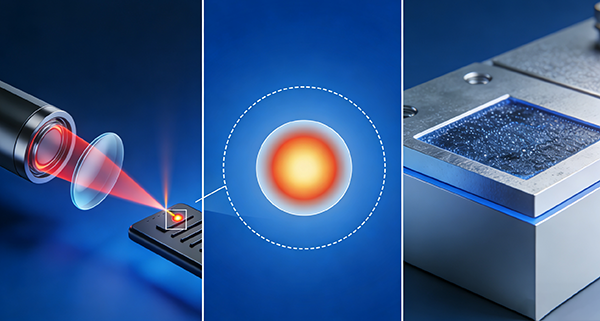
Energy is concentrated only at the focal point inside the glass, so the surface experiences low energy density and remains unaffected.
Deep Explanation
Energy Distribution Along the Beam
Before focusing:
- Energy density is low
- No interaction with material
At the focal point:
- Energy density peaks9
- Optical breakdown occurs
After the focal point:
- Energy decreases again
Gaussian Beam Behavior
Laser beams follow a Gaussian profile:
| Region | Energy Density |
| Before focus | Low |
| Focal point | Maximum |
| After focus | Decreasing |
Only the focal point reaches the threshold required for modification.
Optical System Role
The focusing system determines:
- Spot size
- Depth accuracy
- Energy concentration
High-quality optics ensure tight focusing and minimal distortion.
Engineering Factors
| Parameter | Impact |
| Numerical aperture | Affects focus size |
| Beam quality (M²) | Determines sharpness |
| Alignment | Controls accuracy |
Thermal Management Importance
Stable laser output depends on effective thermal management10. Temperature variations can shift wavelength and reduce focusing accuracy, which impacts engraving precision.
Practical Insight
The surface remains intact because it never reaches the energy threshold required for optical breakdown.
Engineering Check
“Laser energy density peaks at the focal point, enabling internal modification without surface damage.”
Only the focal region exceeds the breakdown threshold.
“The highest laser energy is always at the material surface during engraving.”
Energy density is highest at the focal point, not at the surface.
My insight
Lasers can engrave inside glass without breaking it because the process operates within a tightly controlled energy window where micro-fractures11 are created locally but never allowed to grow or connect.
In real engineering terms, the challenge is not generating internal damage—it is precisely limiting that damage so that:
- Each micro-fracture remains isolated
- No cumulative stress builds up
- The material’s structural integrity is preserved
This depends on:
- Accurate pulse energy control
- Proper micro-point spacing strategy
- Stable focusing inside the material
Bottom Line for B2B Buyers:
If the system cannot maintain strict control over fracture size and distribution, internal engraving 12will lead to hidden stress accumulation—and eventual glass failure.
- This link will explain the precise mechanism of laser engraving on glass, which is crucial for understanding its advantages over traditional methods. ↩︎
- This concept is crucial for understanding how lasers can engrave inside glass without causing surface damage, making it a valuable resource for those interested in the science behind the process. ↩︎
- This resource explains the microscopic mechanism behind localized micro-fractures in glass, offering valuable insights into laser engraving’s precision and non-damaging nature. ↩︎
- This resource explains how high-intensity pulsed lasers enable nonlinear absorption, allowing precise internal modification of transparent materials like glass. ↩︎
- Avalanche ionization is a critical process in nonlinear absorption that enables precise internal modification of materials like glass, making it essential for understanding laser engraving mechanisms. ↩︎
- This keyword focuses on the engineering techniques used to create micro-fractures safely, offering insights into the industrial applications of laser engraving in glass. ↩︎
- This keyword explores the mechanism behind localized micro-fractures and their role in preventing cracks from spreading, which is crucial for understanding the reliability of internal engraving in glass. ↩︎
- This resource explains the critical role of plasma in creating controlled micro-fractures, offering insights into the science behind safe and precise internal engraving in glass. ↩︎
- Understanding how energy density peaks at the focal point is crucial for grasping the mechanism behind surface damage prevention in laser processing. ↩︎
- Thermal management ensures stable laser output and prevents energy threshold shifts, which are critical for maintaining engraving precision and avoiding surface damage. ↩︎
- This resource will explain the precise techniques used to control micro-fractures, ensuring glass remains intact during engraving. ↩︎
- This link will provide insights into the technical hurdles and solutions for achieving successful internal engraving in glass. ↩︎