High-precision UV lasers rely on one hidden hero — the pump source. Without it, no UV photon would ever be born.
A UV laser depends on a stable, wavelength-locked semiconductor pump source to achieve its power, stability, and narrow beam quality.
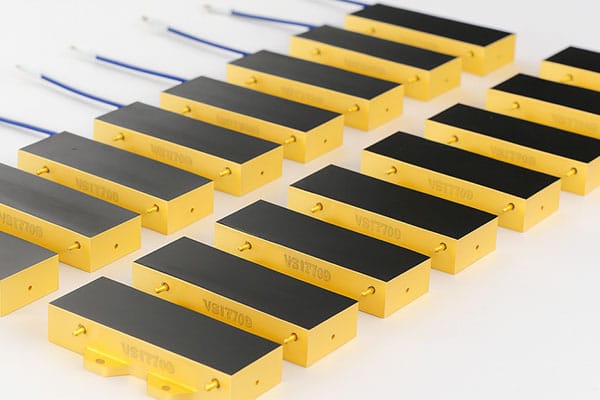
A pump source is the heart of a UV laser system. It determines output power, stability, and lifetime. Let’s explore how Vivlaser’s advanced 878 nm pump modules enable the next generation of DPSS UV lasers.
What Is a UV Laser and Why Does It Need a Pump Source?
UV lasers are solid-state lasers that generate ultraviolet light through nonlinear frequency conversion. They need a pump source to excite the gain medium and create population inversion.
A UV laser uses a semiconductor pump source1 to excite a crystal like Nd:YVO₄12, which then converts near-infrared light into UV through harmonic generation.

Dive deeper
A DPSS (diode-pumped solid-state) UV laser starts with a semiconductor laser diode that emits infrared light. This light pumps the crystal, usually Nd:YVO₄12, to produce a 1064 nm fundamental wavelength. The beam then passes through nonlinear crystals to create 532 nm (green) and finally 355 nm (UV) light through third-harmonic generation.
Without a precise and stable pump source, this entire process collapses. Even slight wavelength drift or power fluctuation can reduce harmonic conversion efficiency or shift the UV output wavelength. That’s why Vivlaser designs narrow-spectrum, wavelength-locked 878 nm pump sources that match the Nd:YVO₄12 absorption peak with ±0.5 nm accuracy, ensuring high absorption efficiency and consistent UV output.
The Role of Pump Sources in DPSS UV Lasers (355 nm)
UV lasers rely on DPSS architecture, where the pump source23 plays the critical role of providing the excitation energy for the laser crystal.
The pump source23 defines the efficiency, beam quality, and stability of a DPSS UV laser.

Dive deeper
A 355 nm UV laser typically uses a solid-state configuration of Nd:YVO₄ as the gain medium, pumped by a high-brightness diode around 878 nm. The laser first generates a 1064 nm IR beam, which is frequency-tripled to 355 nm.
The pump diode must operate at a wavelength precisely matched to the crystal’s absorption peak to minimize thermal loading and improve optical conversion. Vivlaser’s 878.6 nm pump modules use VBG (Volume Bragg Grating) wavelength locking4 to ensure narrow linewidths (15,000 h).
Vivlaser’s 878 nm series meets all these criteria with power options from 25 W to 175 W, available in 200 µm/400 µm fiber-coupled formats, supporting industrial and medical UV laser integrators globally.
Conclusion
UV laser performance begins and ends with the pump source. Vivlaser’s 878 nm wavelength-locked pump modules deliver the precision, stability, and efficiency that next-generation UV laser systems demand.
- Explore this link to understand the critical role of semiconductor pump sources in enhancing UV laser performance. ↩
- Learn about Nd:YVO₄'s significance in UV lasers and how it contributes to efficient light conversion. ↩ ↩ ↩
- Understanding the pump source's role can enhance your knowledge of laser efficiency and stability. ↩ ↩
- Exploring VBG technology can provide insights into achieving high reliability and precision in laser applications. ↩
- Exploring the process of achieving 355 nm output can enhance your knowledge of laser technology and its applications. ↩
- Understanding Output Power is crucial for optimizing UV laser systems and enhancing their efficiency. ↩
- Exploring Coupling Efficiency can reveal ways to minimize losses and improve overall laser performance. ↩
- Explore the benefits of 878 nm pump sources, including efficiency and heat management, to enhance your UV laser applications. ↩
- Learn about the limitations of 808 nm pumps and why transitioning to newer technologies can improve your UV laser performance. ↩
- Explore this link to understand how fiber-coupled pump sources enhance stability and performance in UV laser systems. ↩