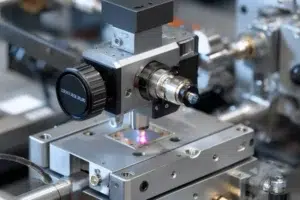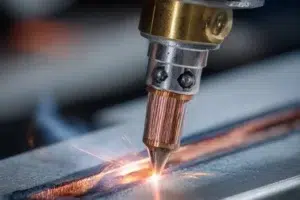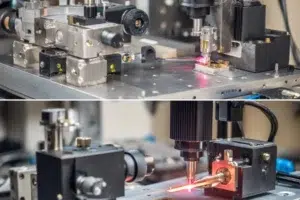
Cracks are mainly caused by excessive pulse energy and poor parameter matching Thermal stress from long pulse durations increases fracture risk Improper focus leads to uncontrolled energy distribution inside glass Micro-point spacing directly affects stress accumulation and crack propagation Stable laser output and proper thermal management are critical to avoid defects
Cracks and breakage are common problems in glass engraving. They reduce product quality and increase rejection rates. Many systems fail due to poor parameter control.
Cracks in laser glass engraving11 are caused by excessive energy, thermal stress, poor focusing, and improper micro-point spacing22, which lead to uncontrolled fracture propagation.

To eliminate defects, you need to understand the root causes from an engineering perspective.
Why Does Excessive Laser Energy Cause Cracks?
Many operators assume higher power improves engraving quality. This often leads to catastrophic results.
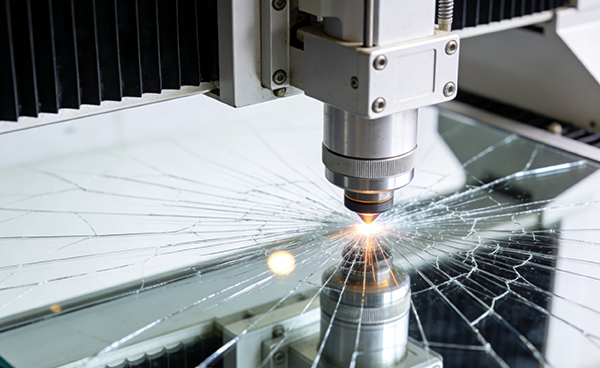
Excessive laser energy creates large micro-fractures and stress concentration, which can propagate into visible cracks or even cause glass breakage.
Deep Explanation
Energy Threshold and Breakdown
Laser engraving requires exceeding the optical breakdown threshold33. However:
- Slightly above threshold → controlled micro-point
- Far above threshold → uncontrolled fracture
What Happens at High Energy
When pulse energy is too high:
- Plasma expansion becomes violent
- Pressure increases significantly
- Micro-fractures grow larger
This creates stress beyond the material’s tolerance.
Crack Formation Mechanism
| Stage | Description |
|---|---|
| Optical breakdown | Plasma forms |
| Expansion | Pressure builds |
| Fracture | Micro-point forms |
| Overload | Crack propagates |
Engineering Trade-off
| Energy Level | Result |
|---|---|
| Low | No engraving |
| Optimal | Clean micro-points |
| High | Cracks and damage |
Role of Laser Stability
Unstable laser output causes:
- Inconsistent micro-point size
- Local stress variation
- Increased crack probability
Stable diode pump sources ensure consistent pulse energy and reduce defect rates in solid-state systems.
Practical Insight
The goal is not maximum energy. It is controlled energy just above the breakdown threshold.
Engineering Check
“Excessive pulse energy increases micro-fracture size and promotes crack propagation.”
Higher energy creates larger stress zones inside the material.
“Increasing laser power always improves engraving clarity without risk.”
Excessive power increases the likelihood of cracks and damage.
How Does Pulse Duration Lead to Thermal Cracks?
Many users ignore pulse duration and focus44 only on power. This creates hidden thermal issues.
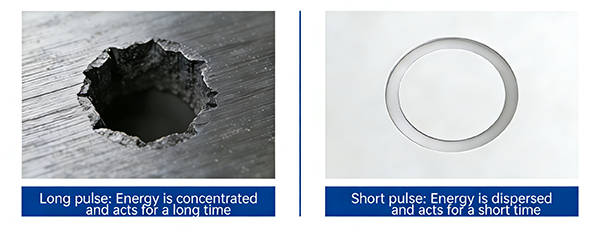
Long pulse durations increase heat diffusion, which generates thermal stress and leads to crack formation.
Deep Explanation
Thermal vs Non-Thermal Interaction
Pulse duration defines how energy is delivered:
- Long pulses → heat spreads
- Short pulses → energy is confined
Thermal Stress Formation
With longer pulses:
- Heat accumulates in surrounding material
- Temperature gradients develop55
- Internal stress increases
Glass is highly sensitive to thermal stress.
Pulse Duration Comparison
| Pulse Type | Thermal Effect |
|---|---|
| Nanosecond | Moderate |
| Picosecond | Low |
| Femtosecond | Minimal |
Why Thermal Cracks Occur
Thermal expansion creates internal stress. If stress exceeds material strength:
- Cracks initiate
- Cracks propagate
Engineering Considerations
- Use shorter pulse durations when possible
- Optimize repetition rate
- Avoid excessive energy accumulation
Role of System Stability
Thermal instability in laser systems can affect pulse characteristics and energy consistency. Effective thermal management improves engraving stability and reduces crack risk.
Practical Insight
Pulse duration is a hidden factor. Even with correct power, long pulses can still cause cracks.
Engineering Check
“Longer pulse durations increase thermal diffusion and can lead to crack formation.”
Heat spreads into surrounding material, creating stress.
“Pulse duration has no effect on crack formation in glass engraving.”
It directly influences thermal behavior and stress generation.
Why Does Poor Focus Cause Internal Damage?
Even with correct energy and pulse settings, poor focus can ruin the process.
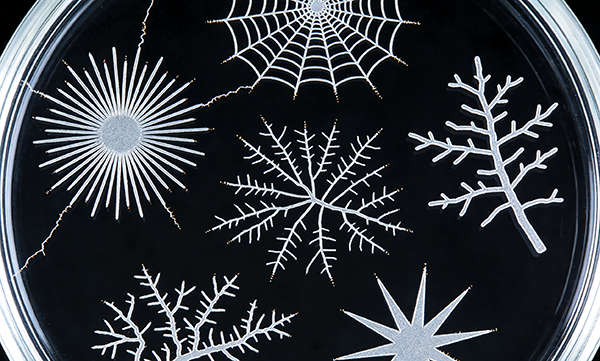
Improper focus causes uneven energy distribution, leading to uncontrolled micro-fractures and internal stress concentration66.
Deep Explanation
Role of Focus in Energy Density
Focus determines energy concentration:
- Tight focus → high energy density
- Defocused beam → low or uneven energy
Effects of Poor Focus
- No optical breakdown at target point
- Energy spreads over a larger area
- Irregular micro-point formation
Resulting Problems
| Issue | Cause |
|---|---|
| Large fractures | Poor localization77 |
| Irregular patterns | Focus instability88 |
| Internal cracks | Stress imbalance |
Depth Control Issues
Incorrect focus depth leads to:
- Surface damage
- Incorrect engraving layer
- Distorted 3D structures
Engineering Factors
| Parameter | Impact |
|---|---|
| Beam quality (M²) | Focus sharpness |
| Optical alignment | Position accuracy |
| Lens quality | Spot size |
Practical Insight
Focus errors are one of the most common causes of engraving defects. Precision optics and alignment are critical.
Engineering Check
“Accurate focusing is required to localize energy and prevent uncontrolled fracture.”
Only a tight focal point can control micro-fracture formation.
“Focus accuracy has little impact on subsurface engraving quality.”
Incorrect focus leads to poor energy control and defects.
How Does Micro-Point Spacing Affect Crack Formation?
Many systems ignore spacing between engraving points. This leads to hidden stress accumulation.
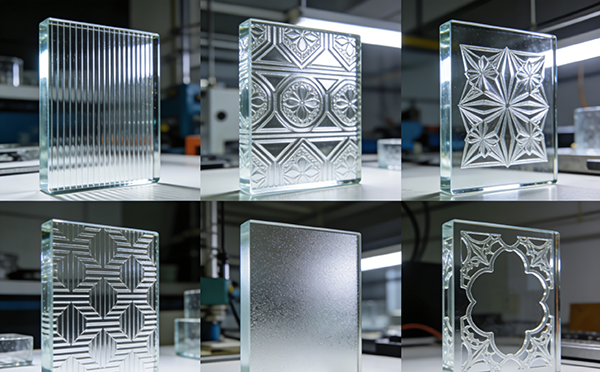
Improper micro-point spacing99 causes overlapping stress fields, which can connect fractures and form visible cracks.
Deep Explanation
Micro-Point Interaction
Each micro-point creates a localized stress field. If points are too close:
- Stress fields overlap
- Internal stress accumulates
- Crack propagation becomes likely
Spacing Control
| Spacing | Result |
|---|---|
| Too close | Crack risk |
| Optimal | Stable structure |
| Too far | Poor image quality |
Stress Accumulation Model
- Single micro-point → isolated stress
- Multiple close points → combined stress
- Continuous region → crack path formation
Engineering Trade-off
- Smaller spacing → higher resolution
- Larger spacing → lower stress
Balance is required.
Process Optimization
- Adjust point density based on material
- Optimize scan strategy
- Control energy per point
Practical Insight
Cracks are often not caused by a single point, but by cumulative stress from multiple points.
Engineering Check
“Overlapping stress fields from closely spaced micro-points can lead to crack formation.”
Stress accumulation increases the likelihood of fracture propagation.
“Micro-point spacing does not affect engraving quality or crack formation.”
Spacing directly influences stress distribution and defect formation.
Conclusion
Cracks in laser glass engraving are caused by excessive energy, thermal effects, poor focus, and improper spacing, all of which must be carefully controlled to ensure stable and high-quality results.
My insight
In glass engraving, cracks are rarely caused by a single parameter—they are the result of energy imbalance across the system1010. Excessive pulse energy, poor focus, or tight point spacing only become critical when combined with unstable output. In real production, the most effective way to reduce cracking is not just parameter tuning, but ensuring consistent pulse energy and thermal stability1111 at the source level.
Cracks in laser glass engraving. ↩
Improper micro-point spacing can lead to stress accumulation and crack propagation, affecting the final product. ↩
Understanding the optical breakdown threshold is crucial for preventing cracks and ensuring quality laser engraving. This resource explains the science behind it and its practical implications. ↩
Understanding how pulse duration and focus interact is crucial for preventing thermal cracks, as both factors influence heat distribution and material stress. ↩
Understanding temperature gradients is crucial for preventing thermal cracks, as they directly impact material stress and integrity. ↩
Micro-fractures and internal stress concentration. ↩
This link will explain how poor localization leads to large fractures and the importance of precise focus in laser processes. ↩
This resource will detail the impact of focus instability on the formation of irregular patterns and the overall quality of the engraving. ↩
Improper micro-point spacing can lead to stress accumulation and crack propagation, affecting the final product. ↩
Energy imbalance across the system. ↩
Thermal stability is crucial for preventing cracks and ensuring consistent results in glass engraving. ↩