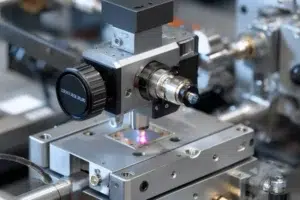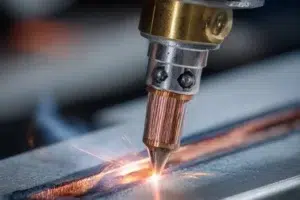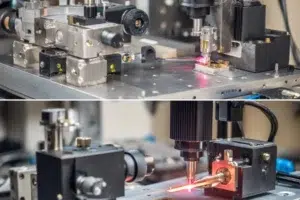
When people hear “diamond is cut by laser”, they usually imagine only the final beam, not the structure hiding behind it.
Most diamond cutting lasers are pumped by high-power semiconductor laser diodes in the 8xx nm band, and 885 nm narrow-spectrum pump sources are a strong choice for stable, efficient systems.
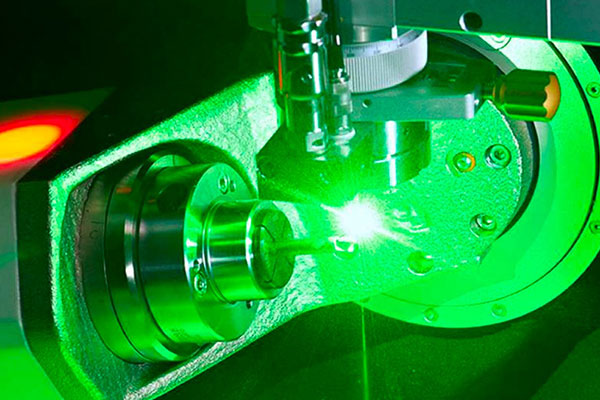
If you build laser machines or integrate laser heads, you know the cutting beam is only as good as the pump behind it. In this article, we stay inside the laser cabinet. We focus on the pump source, and explain why many new gemstone cutting designs move from older pump choices to 885 nm modules.
Why Do Diamond Cutting Lasers Need a Pump Source?
The laser beam that reaches the diamond does not come directly from a diode bar or chip.
In most gemstone cutting systems, semiconductor pump lasers feed a gain medium1, such as a solid-state crystal or fiber, which then generates the actual cutting beam.

From Pump Diode to Cutting Beam
A typical diamond cutting laser has several layers. You can imagine them as a stack:
| Layer | Component Type | Main Role |
|---|---|---|
| Pump layer | 8xx nm diode module (e.g. 885 nm) | Provides optical energy |
| Gain layer | Nd-based crystal or doped fiber | Converts pump into laser at new wavelength |
| Conversion / shaping | Nonlinear crystal, resonator optics | Adjusts wavelength and beam properties |
| Output layer | Delivery fiber and focusing optics | Sends defined spot into the diamond |
The pump layer2 is the “engine”. If the pump wavelength is wrong, or unstable, the gain layer will work with lower efficiency. It will run hotter. It will also show more drift over time. All of this shows up at the output as lower power, more noise, and less reliable cutting performance.
For gemstone cutting, many laser builders use:
- UV or green DPSS lasers based on Nd:YVO₄ or similar crystals.
- Infrared fiber lasers for some shaping and drilling tasks.
Both types rely on efficient, narrow-band pumping around a specific absorption line. That is where the choice of 885 nm pump sources becomes important.
Why Simple “High Power” Is Not Enough
It is easy to think that higher pump power always means stronger cutting. In practice, power alone is not a good guide. The pump source must also provide:
| Parameter | Why It Matters |
|---|---|
| Center wavelength | Must match the absorption peak of the gain medium1 |
| Spectral width | Narrow band improves absorption and reduces heat |
| Wavelength stability | Keeps the laser behavior predictable over time |
| Beam and fiber specs | Must match the laser head design and optics |
If these parameters drift, the machine may still cut, but performance becomes less stable. For a diamond cutting line that runs many high-value stones, this is not acceptable. This is why system builders look beyond “watts”, and start from a clear pump wavelength strategy.
Why 885 nm Pump Sources Are a Smart Choice for Gemstone Cutting Lasers?
Traditionally, many Nd-based solid-state lasers used 808 nm pump diodes. Now more designs move to 880–890 nm, and 885 nm is a very important point in this range.
885 nm pump sources3 sit closer to specific absorption lines of Nd-based crystals4, which improves efficiency and lowers thermal load, especially at high power.
808 nm vs 885 nm in Practical Terms
We can compare 808 nm and 885 nm pumping from a system perspective:
| Aspect | 808 nm Pumping | 885 nm Pumping |
|---|---|---|
| Absorption match | Good in many designs | Closer to certain Nd transitions |
| Quantum defect and heat | Higher heat inside crystal | Lower heat, less thermal lensing5 |
| Beam quality at high power | More risk of distortion | Easier to keep a clean mode |
| Long-term stability | Needs stronger thermal management | More stable under similar conditions |
| Suitability for fine gemstone cuts | Adequate for many tasks | Better for tight tolerance and long runs |
For gemstone cutting6, better thermal behavior and beam quality are not just technical “nice to have” points. They directly affect:
- Kerf width and edge quality.
- Risk of internal stress near the cut.
- Ability to run long production batches without constant re-tuning.
As more cutting houses move to complex shapes, thinner parts, and higher throughput on lab-grown diamonds, these factors become more important. 885 nm pump sources3 help system designers hit these targets without over-complicating the laser head.
How Vivlaser Positions Its 885 nm Pump Sources
Vivlaser focuses on semiconductor laser modules that work as pump sources in solid-state and fiber lasers. For gemstone cutting4 and precision processing, we offer 8xx nm modules, including locked-wavelength 885 nm products, designed for OEM integration.
In this field, we pay special attention to:
- Wavelength control around 885 nm, so absorption stays high inside the gain medium.
- Narrow spectral output, which boosts efficiency and reduces heat.
- High-power, fiber-coupled designs with standard core sizes and NA, which simplify machine layout.
- Long-term reliability and strict testing, which support 24/7 industrial duty.
For laser equipment manufacturers, this means you can design cutting systems that are more compact and more stable, while reducing the time spent on pump-related troubleshooting.
What Should Equipment Builders Look for in 885 nm Pump Modules?
Choosing a pump source is not just a catalog decision. It shapes your whole laser product line.
For diamond cutting lasers, the ideal 885 nm pump module combines stable wavelength, narrow spectrum, strong coupling, and a robust thermal design that supports long life.

Key Selection Points for 885 nm Pump Sources
When you evaluate pump modules for gemstone applications, you can use a simple checklist:
| Selection Point | Practical Question for the Builder |
|---|---|
| Wavelength spec and drift | Does the module stay near 885 nm across current and temperature? |
| Spectral width | Is the spectrum narrow enough for your gain crystal? |
| Output power and fiber type | Does the fiber core and NA match your laser head? |
| Thermal management | Is the package designed for stable cooling in your system? |
| Reliability data | Is there clear lifetime test data under realistic drive conditions? |
| Customization capability | Can the supplier adjust details for your OEM design? |
Vivlaser, as a professional semiconductor laser pump source manufacturer, works directly with industrial equipment makers, medical and aesthetic device brands, and research users. We support OEM and small-batch customization for 8xx nm modules, including 885 nm pump sources for cutting and micro-processing lasers. For gemstone cutting machine builders, this means you can align the pump design with your own optical, mechanical, and control architecture, rather than forcing your design around a generic module.
Conclusion
When you talk about “laser diamond cutting”, you are really talking about a full stack of components. At the base of this stack sits the pump source.
885 nm semiconductor pump modules give diamond cutting lasers higher efficiency, better thermal behavior, and more stable performance, which helps integrators deliver cleaner cuts and more reliable systems to their own customers.
-
Explore the significance of gain mediums in lasers to grasp their impact on cutting efficiency. ↩ ↩
-
Understanding the pump layer’s function is crucial for optimizing laser performance in diamond cutting. ↩
-
Explore the advantages of 885 nm pump sources for improved efficiency and thermal management in gemstone cutting. ↩ ↩
-
Learn about Nd-based crystals and their role in enhancing laser performance and efficiency. ↩ ↩
-
Understand thermal lensing and its impact on laser quality and stability during operation. ↩
-
Discover the latest innovations in gemstone cutting technology for improved precision and efficiency. ↩