When metal welding fails due to spatter, cracks, or poor bonding, manufacturers lose time and money. For materials like copper and aluminum, even traditional lasers struggle to deliver clean, strong welds. Is there a better solution?
Red-blue hybrid lasers combine the energy density of fiber lasers with the absorption efficiency of blue lasers to deliver cleaner, stronger, and more stable welds on challenging metals like copper and aluminum.

While conventional fiber lasers face limits with highly reflective materials, hybrid solutions open new possibilities. In this article, we explore how Vivlaser’s 200W blue + 1000W fiber hybrid laser system is solving some of the toughest welding challenges in modern manufacturing.
Why is hybrid laser welding better for copper and aluminum?
Copper and aluminum reflect infrared light, which leads to energy loss and unstable welding. This makes high-speed, high-quality welding difficult.
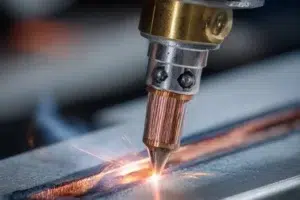
A hybrid laser system1 blends high-absorption blue light (450nm) with high-power fiber light (1080nm) to achieve deeper penetration, better fusion, and more stable welding processes.
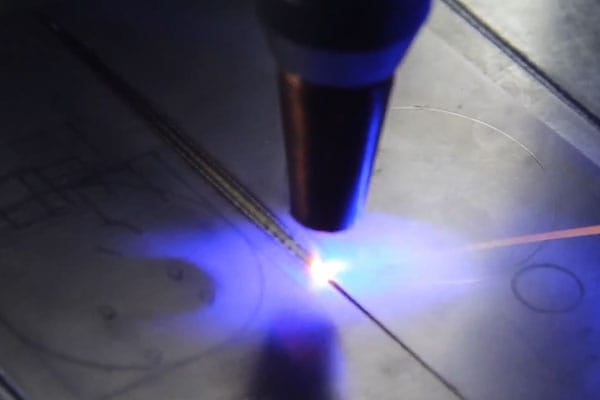
Understanding material interaction with different wavelengths
| Material | IR Absorption (1080nm) | Blue Light Absorption (450nm) |
|---|---|---|
| Copper | Very low | High |
| Aluminum | Moderate | Moderate |
Blue lasers improve energy coupling on copper and aluminum. But their limited power restricts industrial usage. Combining them with fiber lasers fills this gap, offering both energy density and absorption control.
Improved weld quality and process stability
The Vivlaser hybrid system features a small 0.4mm spot size, ideal for precision. Key benefits include:
-
Reduced spatter and porosity
-
Enhanced control of heat input
-
Better seam aesthetics
-
Higher welding speed
How does the Vivlaser 200W + 1000W hybrid laser work?
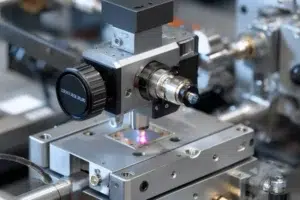
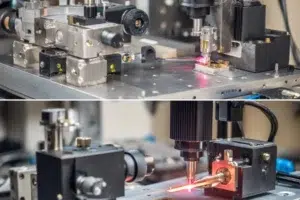
A red-blue hybrid system integrates two wavelengths—450nm blue and 1080nm infrared—in one optical path. This creates a dynamic heat profile suitable for difficult materials.
Vivlaser’s hybrid laser delivers 200W blue + 1000W fiber output in a single, compact setup. The beams are precisely aligned and focused into a 0.4mm spot for maximum energy efficiency.
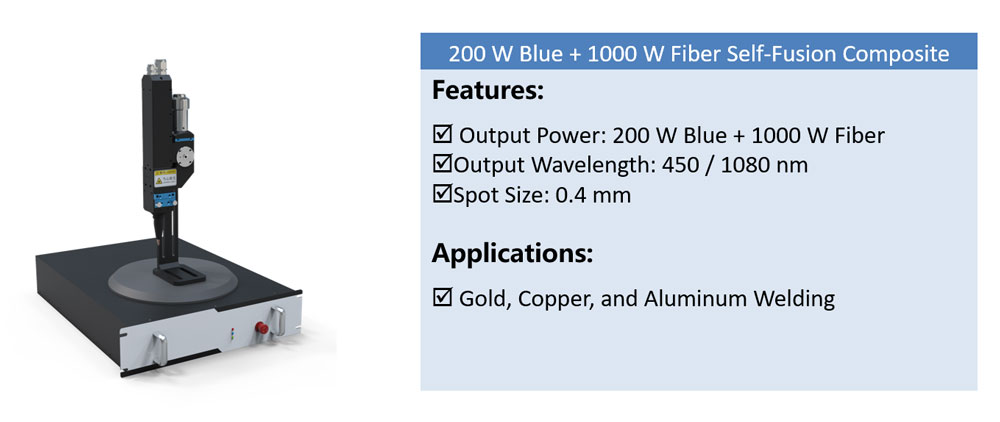
Key performance specifications
| Parameter | Specification |
|---|---|
| Output Power | 200W Blue + 1000W Fiber |
| Wavelength | 450nm / 1080nm |
| Spot Size | 0.4mm |
| Application Focus | Copper-aluminum welding |
This system supports plug-and-play installation in smart welding stations. Its structure integrates water cooling and beam alignment features, ensuring stable long-term operation.
Typical industrial applications
-
Battery tab welding (Cu-Al)
-
EV component joining
-
3C electronics
-
Aerospace precision parts
How does this help your business scale?
Hybrid laser welding reduces defects, improves yields, and simplifies material selection. This leads to faster production cycles and fewer customer complaints.
For integrators, OEMs, and high-end manufacturers, Vivlaser’s red-blue hybrid solution offers a reliable path to high-quality, high-throughput metal processing.
Competitive advantages of the Vivlaser system
| Feature | Benefit |
|---|---|
| Hybrid Wavelength | Compatible with difficult metals |
| Small Spot Size (0.4mm) | High precision welding |
| Compact Integration | Easy to mount and align |
| High Output Stability | Reduced maintenance and downtime |
| Proven in Cu-Al Welding | Ideal for batteries and connectors |
Conclusion
Hybrid lasers are shaping the future of precision welding. With Vivlaser’s 200W blue + 1000W fiber system, manufacturers can weld smarter, faster, and with fewer defects.
-
Explore this link to understand how hybrid laser systems enhance welding efficiency and quality, especially for challenging materials. ↩