Struggling to weld copper with traditional lasers? Blue lasers solve absorption issues—but only when delivered efficiently.
Blue lasers alone have shallow penetration depth, making them insufficient for full-depth welds. Fiber coupling enables hybrid welding with 1064nm fiber lasers, unlocking full industrial performance.

In this article, we’ll compare standalone and fiber-coupled blue laser modules, explore their structural differences, and explain why fiber coupling is essential for high-performance applications like battery welding, additive manufacturing, and aerospace engineering.
What Is the Difference Between Standalone and Fiber-Coupled Blue Laser Modules?
Frustrated by inconsistent beam delivery or system bulkiness? You’re not alone—many engineers face the same integration barriers.
Standalone blue laser modules emit laser light directly in space, while fiber-coupled blue lasers transmit beams via optical fibers for more flexible delivery.
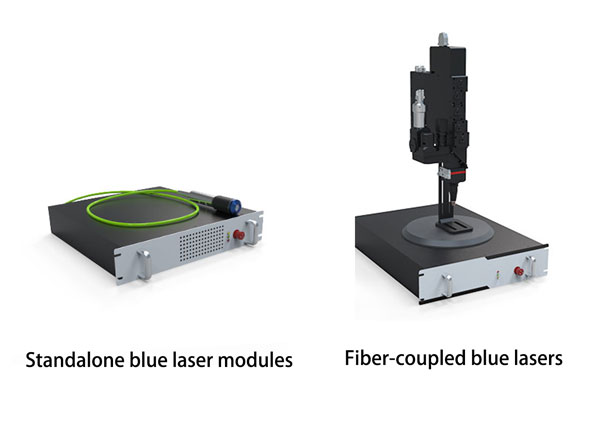
Structural Differences Between Standalone and Fiber-Coupled Blue Lasers
| Feature | Standalone Blue Laser Module | Fiber-Coupled Blue Laser Module |
|---|---|---|
| Beam Delivery | Open-air path | Enclosed fiber optics |
| Integration | Large, complex setup | Compact, modular design |
| Safety | Requires shielding | Safer, enclosed transmission |
| Beam Control | Needs external optics | Pre-shaped at the source |
Standalone blue laser modules emit beams directly from diode arrays and shape them through collimation lenses. This setup is relatively simple but bulky, and often difficult to integrate into automated systems. In contrast, fiber-coupled blue lasers combine multiple diode outputs and transmit the unified beam through optical fibers—enabling remote delivery, compact layouts, and safer operation.
Why Is Fiber Coupling Critical in Industrial Blue Laser Applications?
You’ve got high absorption but low depth—now what? Without beam shaping and delivery control, you can’t fully utilize blue laser advantages.
Fiber coupling enhances power stability, enables hybrid integration, and improves safety and automation readiness.
How Fiber Coupling Solves Real-World Problems
1. Power Scaling and Beam Stability
High-power fiber-coupled blue lasers, such as Vivlaser’s V1-B1000F3000 model, combine beams from multiple blue diodes through polarization and spatial techniques. The resulting beam is transmitted via a single fiber with excellent stability. This setup meets the needs of industrial users demanding kilowatt-level output with consistent performance.
2. Remote Delivery for Automation
Fiber delivery enables laser heads to move independently of the source. This is crucial for automated welding arms and CNC systems. It reduces vibration effects and improves machining precision, especially in multi-axis motion environments.
3. Thermal Management and Maintenance
Because the fiber transmits light rather than heat, all heat-generating components remain near the power supply. This design keeps the laser head cool and reduces the need for complex on-arm cooling systems. It also simplifies maintenance and prolongs the head’s service life.
4. Workplace Safety and Regulatory Compliance
Standalone modules often emit open beams that require significant shielding. In contrast, fiber-coupled blue laser modules confine the beam within the fiber until the output point—easing CE, ROHS, and other compliance requirements.
5. Easy Integration with 1064nm Fiber Lasers for Hybrid Welding
Hybrid welding heads combine blue and 1064nm fiber lasers to maximize absorption and penetration. Fiber output simplifies this merging process, creating stable, deep welds with excellent metallurgical properties. Vivlaser’s fiber-coupled modules are compatible with many fiber laser welding systems.
What Are the Main Use Cases for Fiber-Coupled Blue Laser Modules?
Precision-demanding environments demand more than raw power—they need stable beam control.
Fiber-coupled blue lasers are used in battery welding, additive manufacturing, and aerospace 3D fabrication where beam flexibility is essential.

Industry Applications That Rely on Fiber-Coupled Blue Laser Modules
Electric Vehicle Battery Welding
Copper tabs and busbars absorb blue light better than IR, allowing smoother welds. Combined with 1064nm fiber lasers, blue lasers increase penetration and bonding strength. Fiber coupling enables robotic arms to operate with agility and precision in EV battery lines.
Metal Additive Manufacturing
Blue lasers improve powder absorption for copper and aluminum. They reduce splatter and porosity, increasing layer consistency. Fiber-coupled delivery ensures the beam reaches all build areas with minimal distortion.
Aerospace & 3D Component Fabrication
Aerospace-grade parts require intricate welds and consistent quality. Fiber-coupled blue lasers offer uniform beam quality and easier control over beam parameters in hard-to-reach zones, especially on curved or composite surfaces.
Medical Device Production
Medical-grade welding demands clean, stable output and compact integration. Vivlaser’s fiber-coupled solutions meet the safety and reliability requirements for surgical tool assembly and implant joining.
When Does a Standalone Blue Laser Module Still Make Sense?
Sometimes simpler is better—especially in labs or low-power tasks.
Standalone blue laser modules remain useful in R&D, educational, and compact setups, and also in specific applications like gold welding and dissimilar metal joining.

Situations Where Standalone Modules Are Still Viable
Lab Research and Prototyping
Researchers often need visible beams for alignment or experiments. Standalone modules allow quick adjustments and reconfiguration without needing fiber tools.
Educational Demonstrations
Laser teaching kits or university-level courses benefit from lower-power, easier-to-observe setups.
Compact Desktop Equipment
Devices like benchtop engravers or low-cost inspection systems benefit from the smaller footprint and cost of standalone blue lasers.
Specific Industrial Scenarios
Standalone blue lasers still perform well in several specialized use cases:
- Gold Welding: Excellent absorption enables clean welds with minimal spatter.
- Dissimilar Metal Welding: Joining copper and stainless steel benefits from blue light’s strong surface interaction.
- High-Reflectivity Metal Welding: Materials like copper and aluminum, which reflect IR poorly, absorb blue wavelengths more efficiently.
Standalone blue lasers continue to offer strong value in compact systems and specialized applications. Their direct-output design suits scenarios where simplicity, visibility, or specific material compatibility—such as gold or dissimilar metals—is essential.
Conclusion
Fiber coupling makes high-power blue lasers industrial-ready—enhancing delivery, control, and flexibility. For applications demanding precision and reliability, it’s the architecture of choice.
Vivlaser offers industrial-grade fiber-coupled blue laser modules, including the V1-B1000F3000 series, designed for advanced welding, hybrid joining, and metal additive manufacturing.
To learn more about industrial blue laser technologies:
445nm Blue Laser Technology Guide
If your application involves copper, aluminum, or other high-reflectivity materials, our engineering team can help you select or customize the ideal laser solution.
👉 Contact us to discuss your project needs, request technical documentation, or arrange a sample evaluation.