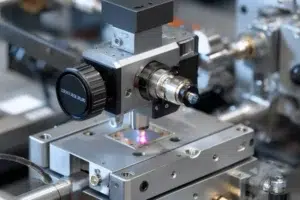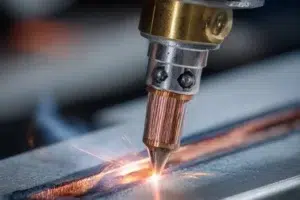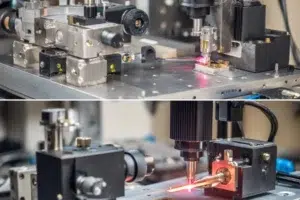
Subsurface engraving works through nonlinear absorption and optical breakdown inside glass Laser energy is only absorbed at the focal point, not along the beam path Micro-fracture points remain localized and do not propagate into cracks Pulse duration controls thermal effects and precision Stable diode pump sources are critical for consistent energy delivery in solid-state systems
Glass is brittle and easy to crack. Traditional machining damages it quickly. This limits precision manufacturing. Laser engraving solves this by modifying only the internal structure11 without stressing the surface.
Lasers engrave inside glass by focusing pulsed energy to trigger optical breakdown at a precise point, creating localized micro-fracture points22 without damaging the surrounding material.
To understand why glass does not break, you need to analyze nonlinear absorption, micro-fracture behavior, and energy focusing33.
What Is Nonlinear Absorption in Glass Engraving?
Glass is transparent to most laser wavelengths. It should not absorb energy. So internal engraving seems impossible.
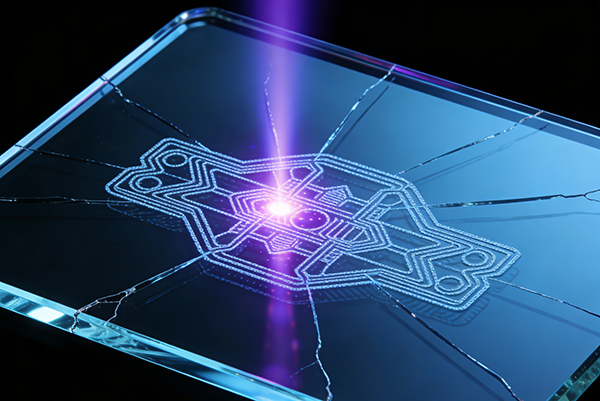
Nonlinear absorption44 allows glass to absorb laser energy only at extremely high intensity, enabling internal modification at the focal point.
Deep Explanation
Linear vs Nonlinear Behavior
Under normal conditions:
- Glass transmits light
- No absorption occurs
- No structural change happens
This is linear optical behavior.
When laser intensity increases significantly, the response becomes nonlinear.
Nonlinear Absorption Mechanisms
At high intensity, several processes occur:
- Multiphoton absorption
- Avalanche ionization
- Plasma generation
These effects only occur when energy density exceeds a threshold.
Why Absorption Is Localized
The laser beam travels through the material without interaction until it reaches the focal point.
| Region | Behavior |
|---|---|
| Before focus | No absorption |
| Focal point | Strong absorption |
| After focus | Energy dissipates |
This creates a highly confined interaction zone.
Engineering Implications
| Parameter | Impact |
|---|---|
| Pulse energy | Determines breakdown threshold |
| Beam quality | Affects focus sharpness |
| Wavelength | Influences transmission |
| Pulse duration | Controls interaction time |
Stable laser output is critical. In solid-state systems, diode pump sources directly affect energy consistency, wavelength stability, and long-term reliability.
Practical Insight
Nonlinear absorption is the key enabler. It allows energy to bypass the surface and act only inside the material.
Engineering Check
“Nonlinear absorption enables transparent materials to absorb laser energy only at high intensity regions.”
Absorption occurs only when the energy density exceeds the optical breakdown threshold.
“Glass absorbs laser energy continuously along the beam path during internal engraving.”
Energy is only absorbed at the focal point where intensity is highest.
Why Do Micro-Fractures Not Break the Glass?
Glass typically fails when cracks propagate. This makes internal damage seem dangerous.
Laser engraving creates extremely small and isolated micro-fracture points that do not propagate, so the overall structure remains intact.

Deep Explanation
Micro-Fracture Formation
When optical breakdown occurs:
- A plasma forms at the focal point55
- Rapid expansion generates localized pressure
- A micro-fracture point is created
Each micro-point is a controlled internal defect.
Why Cracks Do Not Spread

Several mechanisms prevent crack propagation:
- Small micro-fracture size
- Rapid energy dissipation
- No continuous stress field
- Controlled spacing between micro-points
Each micro-point is independent.
Stress Control Factors
| Factor | Role |
|---|---|
| Pulse energy66 | Limits fracture size |
| Micro-point spacing | Prevents stress overlap |
| Material quality | Improves crack resistance |
Role of Pulse Duration
Short pulses reduce heat diffusion:
- Less thermal stress
- Smaller damage zone
- Better control of fracture size
This is why nanosecond and picosecond lasers are commonly used.
Engineering Insight
The process is not random cracking. It is controlled micro-structuring. Each micro-point is engineered to stay below the crack propagation threshold.
Practical Implications
- No surface damage
- No structural failure
- High repeatability in production
Engineering Check
“Micro-fractures remain localized because stress is confined and does not propagate.”
Controlled energy input ensures fractures remain small and isolated.
“Any internal crack in glass will always propagate and cause failure.”
Only large or connected cracks propagate. Controlled micro-fractures do not.
How Do Power, Pulse, and Focus Work Together?
Many systems fail because parameters are not matched. Power, pulse, and focus must be coordinated.
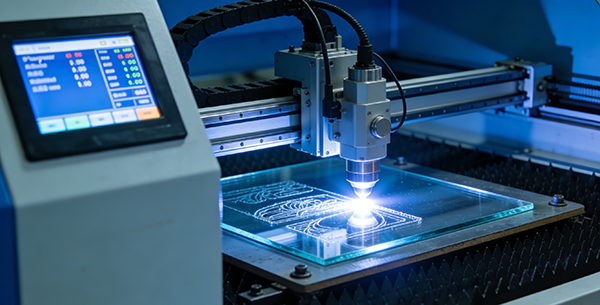
Laser power, pulse duration, and focus determine energy density77, which controls whether optical breakdown occurs and how micro-points are formed.
Deep Explanation
Power (Energy Input)
Power determines whether breakdown occurs:
- Too low → no micro-point
- Optimal → clean micro-point
- Too high → crack risk
Pulse Duration (Time Control)
Pulse duration defines how energy is delivered:
| Type | Effect |
|---|---|
| Nanosecond | Moderate precision |
| Picosecond | High precision |
| Femtosecond | Ultra precision |
Shorter pulses reduce thermal diffusion.
Focus (Spatial Control)
Focus determines where energy is concentrated:
- Tight focus → high energy density
- Poor focus → no breakdown
Combined Effect
| Parameter | Role |
|---|---|
| Power | Energy level |
| Pulse | Time control |
| Focus | Spatial localization |
All three define energy density at the focal point.
System-Level Requirements
To maintain consistency, systems require:
- Stable laser output
- Precise optical alignment
- Accurate motion control
Thermal management is critical88. Temperature variations affect wavelength and output stability, which directly impacts engraving quality.
Practical Insight
The key is not maximum power. It is controlled energy density at the correct position and time.
Engineering Check
“Energy density at the focal point determines whether optical breakdown occurs.”
Breakdown requires energy to exceed a threshold within a confined region.
“Increasing laser power alone guarantees better engraving quality.”
Power must be balanced with pulse duration and focus to avoid damage.
Beam Profile and Optical System Role Laser beams follow a Gaussian energy profile: energy density is low before the focal point, peaks at the focal point, and decreases afterward. Only the focal point reaches the threshold required for internal modification.
Region Energy Density Before focus Low Focal point Maximum After focus Decreasing The optical system's numerical aperture and beam quality (M²) determine focus sharpness and depth accuracy, while alignment controls overall accuracy. High-quality optics ensure tight focusing and minimal distortion — directly affecting how cleanly each micro-fracture point forms.
Conclusion
Lasers engrave inside glass by combining nonlinear absorption, controlled micro-fractures99, and precise energy focusing, enabling internal modification without surface damage or structural failure.
My insight
Subsurface glass engraving is not driven by power alone, but by how precisely energy is delivered in time and space. In real production environments, the difference between clean internal marking and micro-crack failure often comes down to pulse stability1010 and beam quality—both of which are directly tied to the reliability of the diode pump source behind the system.
Laser engraving solves this by modifying only the internal structure. ↩
Micro-fracture points. ↩
Nonlinear absorption, micro-fracture behavior, and energy focusing. ↩
Nonlinear absorption. ↩
A plasma forms at the focal point. ↩
Pulse energy. ↩
Laser power, pulse duration, and focus determine energy density. ↩
Thermal management is critical. ↩
Controlled micro-fractures. ↩
Pulse stability. ↩