Key Takeaways
Memorial crystal engraving is growing because buyers want durable, premium, and personalized remembrance products.
Product quality depends on laser control, optical consistency, material purity, and thermal stability during engraving.
Cost is driven by crystal grade, engraving depth, image complexity, yield rate, and finishing requirements.
Buyers should evaluate suppliers on process control, customization ability, delivery reliability, and documentation.
For B2B customers, the best suppliers balance visual quality, repeatability, and scalable production.
Families want memorial products that last, but many options fade or feel generic. That creates demand for premium alternatives. Memorial crystal engraving solves this with durable, personalized, and visually distinctive products.
Yes. Memorial crystal engraving is a growing market because it combines emotional value with premium appearance1, long product life, and high customization. It also fits e-commerce gifting, funeral services, and personalized keepsake demand.
The market looks simple from the outside, but the real growth comes from material science, laser processing, and supplier execution. That is where buyers should focus.
Why is demand for memorial crystal engraving increasing?
Standard memorial products often look similar, and buyers want something more personal. When products feel generic, value drops. Crystal engraving offers a premium and lasting alternative.
Demand is increasing because crystal products combine personalization, durability, and gift value. They work well for family remembrance, funeral service packages, and online custom ordering.
Deep Explanation
Emotional demand is becoming a product category
Memorial purchasing is different from standard gift purchasing. Buyers are not only choosing a product. They are choosing how memory will be preserved. That changes buying behavior. In this category, appearance, permanence, and emotional meaning matter more than price alone.
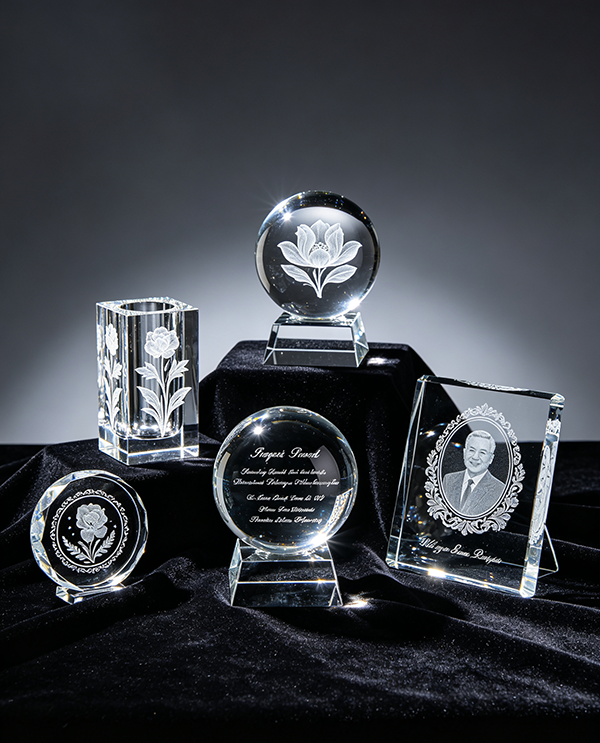
Crystal performs well in this environment because it signals quality. It feels permanent, clean, and respectful. Unlike paper prints or coated surfaces, the engraved image is protected inside the material. That gives customers confidence that the product will not easily wear out during normal handling.
Personalization is now expected, not optional
The growth of online customization has changed the market. Customers now expect to upload a portrait, add text, choose shapes, and approve a final design before production. Memorial crystal fits this workflow very well because the same base product can support many personalized outputs.
This makes the product attractive for several channels:
| Channel | Why crystal engraving fits |
| Funeral homes | Can offer premium remembrance packages |
| E-commerce sellers | Easy to customize with photo and text |
| Gift distributors | High perceived value and low SKU complexity |
| Memorial service providers | Strong emotional positioning |
Premium positioning supports margin
From a buyer perspective, this is important. Memorial crystal engraving is not only a craft product. It is a premium manufactured product with strong emotional pricing power. That means buyers can often support higher margins than in standard souvenir categories.
Growth also comes from visual differentiation
Light interaction is one more reason for growth. Crystal can create a floating image effect, especially with 2D and 3D internal engraving. This visual result is difficult to match with wood, acrylic, or metal plates. So the product stands out in both retail display and online product images.
For professional buyers, the market growth signal is clear: this category wins when emotional value and technical presentation work together.
Engineering Check
“Internal crystal engraving protects the image inside the material, so surface wear has less effect on long-term appearance.”
The engraved points are formed inside the crystal volume, not printed on the outside surface. So normal rubbing or light contact does not remove the image.
“Any transparent block can deliver the same memorial engraving quality as optical crystal.”
Material purity, internal stress, and optical uniformity strongly affect image clarity. Lower-grade transparent materials often show haze, distortion, or cracking risk.
What makes crystal engraving technically suitable for memorial products?
Some materials look premium at first, but they scratch, discolor, or lose detail. That hurts long-term value. Crystal keeps form and visual quality much better.
Crystal is technically suitable because it offers optical clarity2, dimensional stability3, and compatibility with precise internal laser engraving4. That combination supports durable and premium memorial products.
Deep Explanation
Optical clarity is the foundation
Memorial engraving depends on image readability. If the material scatters too much light, the portrait or text loses depth and contrast. Optical crystal is preferred because it has high transparency and a more uniform internal structure. That helps laser-generated points appear sharper and more controlled.
For memorial applications, this matters because many designs depend on subtle grayscale conversion and facial detail. A low-quality blank can ruin a good engraving file.
Internal laser engraving supports permanence
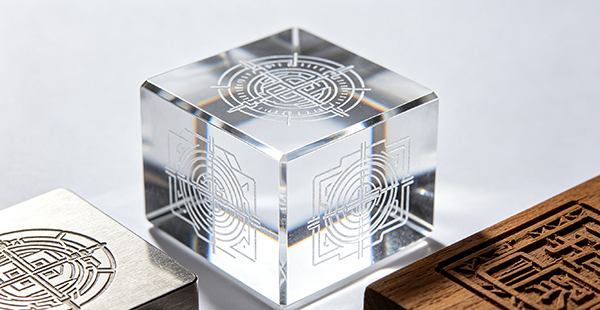
Most memorial crystal products use focused laser energy to create micro-fracture points inside the crystal. These points form text, portraits, or 3D models. Because the mark is inside the crystal, the outer surfaces remain smooth. This gives two practical benefits:
- The product keeps a premium finish5.
- The image remains protected from direct abrasion.
This is a strong technical advantage over surface printing or coating.
Crystal geometry improves presentation
Shape selection also affects market appeal. Cubes, rectangles, hearts, and custom bevel designs all change how the image is viewed. Thicker blocks can provide stronger depth effect, but they also require better focusing and stronger process consistency.
Here is a simple engineering view:
| Technical factor | Effect on memorial product |
| Optical purity | Improves image sharpness |
| Internal stress level | Affects cracking risk |
| Block thickness | Changes depth effect and focus demand |
| Surface polish | Increases premium appearance |
| Edge accuracy | Supports better light transmission |
Lighting compatibility adds product value
Many memorial crystal products are paired with LED bases. This is not only decorative. Lighting increases contrast and makes internal engraving easier to see. For B2B buyers, that means a crystal product can become a system product: engraved crystal plus light base plus gift packaging. Average order value goes up.
The material supports standardized production
Another reason crystal works well is process repeatability6. Once the supplier controls blank quality, laser settings, and design workflow, production can scale more easily than many hand-finished memorial products. That makes the category attractive for wholesalers and OEM buyers.
Engineering Check
“Optical consistency inside the crystal directly affects how clearly an internal engraved image can be seen.”
Laser points interact with the bulk material. Inclusions, bubbles, and internal stress can reduce contrast and distort the final image.
“Surface polishing quality does not matter because the engraving is inside the crystal.”
Even when the image is internal, poor surface finishing reduces light transmission and lowers the overall premium look of the product.
Which manufacturing factors drive cost and quality?
Many buyers compare only unit price. Then they face rejects, blur, cracks, or delays. In crystal engraving, process control drives both cost and customer satisfaction7.
The main cost and quality drivers are crystal grade, engraving complexity, machine precision, yield rate, finishing, and packaging8. Stable production lowers defect cost and improves delivery performance.
Deep Explanation
Material cost is only the first layer
Crystal blank cost is visible, so many buyers focus there first. But in practice, the blank is only one part of the total cost. The bigger issue is how material quality affects yield. A cheaper block with poor optical quality can create more rejects. That often raises real cost.
Engraving complexity changes machine time
A simple line of text and a 3D portrait do not cost the same to produce. The more internal points the laser must generate, the longer the processing time. Portrait conversion, image cleanup, point density, and depth design all affect throughput.
This is why two memorial crystals with similar size can have very different production cost.
| Cost driver | Impact on total cost |
| Crystal quality | Higher blank cost but better yield |
| Portrait complexity | More file preparation and laser time |
| 2D vs 3D engraving9 | 3D usually needs more processing |
| Size and thickness | More material and stricter process control |
| Polishing and beveling | Adds finishing labor or equipment time |
| Gift box and LED base | Increases packaging cost and product value |
For professional buyers, yield is one of the most important metrics. Internal cracks, point distortion, broken corners, and design misalignment all reduce usable output. A supplier with good process control can often outperform a cheaper competitor simply because fewer pieces fail.
Equipment and process stability matter
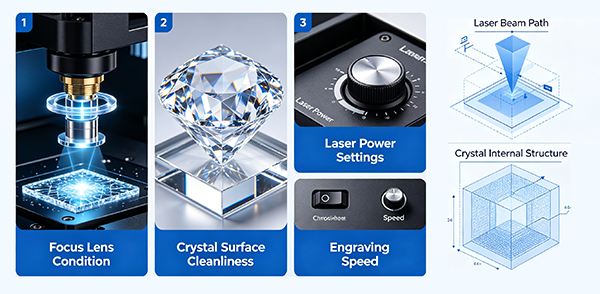
Laser pulse stability, motion control accuracy, focus consistency, and fixture quality all affect output repeatability. This is why memorial crystal should be treated as a precision product, not a simple craft item.
Suppliers that understand engineering will manage:
- input file standards
- crystal blank inspection
- parameter libraries by shape and size
- final visual inspection
- protective packaging for transport
Packaging also affects delivered quality
Crystal is heavy and brittle compared with many gift products. So logistics protection is part of the quality system. A perfect product can still become a damaged shipment if packaging design is weak. Buyers should treat packaging validation as part of supplier qualification.
Engineering Check
“Lower reject rates can reduce total product cost more effectively than a small reduction in raw crystal price.”
When reject cost, rework, and delayed shipment are included, process yield often has a larger effect on profitability than minor raw material savings.
“Memorial crystal engraving cost is determined mainly by crystal size.”
Size matters, but image complexity, setup time, finishing, packaging, and defect rate also significantly change real production cost.
How should buyers choose a memorial crystal engraving supplier?
A supplier may offer attractive prices, but weak process control causes complaints later. Late delivery and inconsistent quality damage customer trust. Supplier selection must go beyond quotation.
Buyers should choose suppliers with stable material sourcing, repeatable engraving quality, customization support10, inspection standards, and reliable lead times. Technical communication is a major selection factor.

Deep Explanation
Start with process capability, not only samples
A good sample proves that a supplier can make one good piece. It does not prove that the supplier can deliver 500 or 5,000 pieces with the same quality. Buyers should ask how the supplier controls repeatability across batches.
Useful questions include:
- How is incoming crystal inspected?
- How are engraving files checked before production?
- What is the defect classification standard?
- How is packaging tested for international shipment?
- What is the rework or remake policy?
Customization ability is part of the value
Memorial orders often include custom text, dates, symbols, or photos. So supplier responsiveness matters. A good supplier should support clear artwork review, practical size recommendations, and fast design confirmation.
For distributors and OEM partners, flexible customization is often more important than the lowest unit price because it helps win more end customers.
Delivery reliability matters in memorial products
This category is time-sensitive. Buyers may need products for specific remembrance dates, funeral events, or family occasions. That means planning, inventory, and response speed are critical.
A strong supplier should demonstrate:
| Supplier capability | Why it matters |
| Stable production schedule | Reduces missed delivery windows |
| Fast artwork confirmation | Speeds order conversion |
| Clear QC records | Builds buyer confidence |
| Protected packaging | Lowers transit damage |
| Responsive support | Solves personalized order issues quickly |
Documentation improves B2B cooperation
Professional buyers should also look for documentation discipline11. That includes specification sheets, order confirmation accuracy, revision control, and complaint handling. These are simple things, but they separate scalable suppliers from trading-only operators.
The best supplier is the one that reduces operational risk
In this market, the real decision is not just product choice. It is risk control. Buyers should choose the supplier that can protect quality, schedule, and customer experience at the same time.
Engineering Check
“Repeatable engraving quality requires control of material input, laser parameters, and inspection standards across every batch.”
Stable output comes from process control, not luck. Without standardization, visual variation appears quickly in custom production.
“A beautiful catalog is enough evidence that a supplier can support long-term memorial crystal OEM business.”
Catalog quality shows presentation ability, but not production discipline. Buyers need evidence of process control, quality systems, and delivery performance.
Conclusion
Memorial crystal engraving is growing because it combines emotional value, premium design, and scalable laser-based manufacturing12 for buyers who need quality, customization, and reliable supply.
My insight
The growth of memorial crystal engraving is not just driven by emotion—it is driven by manufacturing consistency behind emotional products13. In this category, buyers are effectively selling trust, which means even small variations in engraving quality can impact customer perception. Suppliers that can maintain stable laser output and low defect rates at scale will outperform others, because consistency—not just aesthetics—is what ultimately builds long-term B2B value.
- This resource will help you understand the strategies and techniques to achieve a premium appearance in memorial products. ↩︎
- Optical clarity is crucial for ensuring that engraved images on crystal products are sharp and visually appealing, which enhances their long-term value and presentation. ↩︎
- Dimensional stability ensures that crystal products maintain their shape and structure over time, which is essential for preserving the quality of internal laser engraving. ↩︎
- Internal laser engraving provides a durable and premium finish, as the engraving is protected from direct abrasion and maintains the product’s visual quality. ↩︎
- A premium finish enhances the overall appearance of the product, making it more attractive and valuable for both personal and commercial use. ↩︎
- Process repeatability ensures consistent quality and scalability in production, making crystal a preferred material for wholesalers and OEM buyers. ↩︎
- This question explores the relationship between process control and overall product quality and cost. ↩︎
- This query identifies the critical factors that influence both cost and quality in the manufacturing process. ↩︎
- This query explores the cost and quality implications of choosing between 2D and 3D engraving techniques. ↩︎
- Customization support is vital for buyers who need unique designs for memorial products, ensuring the supplier can meet specific requirements. ↩︎
- Ensuring repeatability across batches is essential for buyers to avoid quality inconsistencies in large memorial crystal orders. ↩︎
- This keyword highlights the technological advantage of laser-based manufacturing, which is crucial for understanding how suppliers can achieve consistency and reliability in producing high-quality, customized memorial crystals. ↩︎
- Manufacturing consistency is a key factor in building long-term B2B value, as it ensures reliable supply and quality, which are essential for customer trust and satisfaction in this emotionally driven market. ↩︎