When semiconductor lasers fail, they don’t just stop working—they can compromise high-end medical equipment, precision industrial systems, and mission-critical research setups. That’s why at Vivlaser, we don’t just manufacture lasers—we engineer them to outperform.
Vivlaser has developed a deep understanding of semiconductor laser failure modes and established a robust reliability assurance system based on accelerated lifetime testing.
Read on to discover how our world-class design, rigorous testing, and decades of expertise make Vivlaser a trusted supplier to global laser device integrators.
What Are the Main Failure Modes in Semiconductor Lasers?
Through years of R&D and collaboration with top-tier clients, we’ve identified three primary failure types:
Early Failures
Caused by defects during fabrication, early failures appear shortly after the product begins operation. These are often the result of:
- Dislocation Loop Defects (DLD) or Dark Spot Defects (DSD)
- Incomplete bonding or contamination during assembly
- Thermal or electrical overstress during initial burn-in
At Vivlaser, we minimize early failure rates by implementing:
- Ultra-clean assembly environments (class 1000 cleanroom)
- Micron-level chip bonding alignment
- Strict screening using elevated temperature pre-aging
The result? Our initial yield and burn-in pass rates exceed 99.5%, making us a reliable partner for volume production.
Random Failures
Random failures are sudden, unpredictable, and often externally induced. Common causes include:
- Electrostatic discharge (ESD)
- Sudden current spikes or power noise
- Mechanical shock from transportation or installation
Vivlaser’s mitigation strategies:
- Integrated transient voltage suppression (TVS) circuits
- Reinforced mechanical packaging against vibration and impact
- Shipment packaging with electrostatic protection certification
By addressing every risk point, we reduce field-return incidents and ensure high reliability even in dynamic operating environments.
Wear-Out Failures (Slow Degradation)
The most common long-term failure mode. Symptoms include:
- Gradual decline in output power
- Wavelength drift
- Spectrum broadening or instability
Causes:
- Facet oxidation or mirror degradation
- Gradual dislocation migration within the active region
- Metal fatigue at bonding interfaces
Vivlaser combats wear-out with:
- Proprietary facet passivation techniques
- High-thermal-conductivity submount materials (e.g., CVD diamond, AlN)
- Efficient fiber coupling and thermal management to reduce junction temperature
Our engineering focus extends laser lifetime without compromising performance.
Why Use Accelerated Lifetime Testing11?
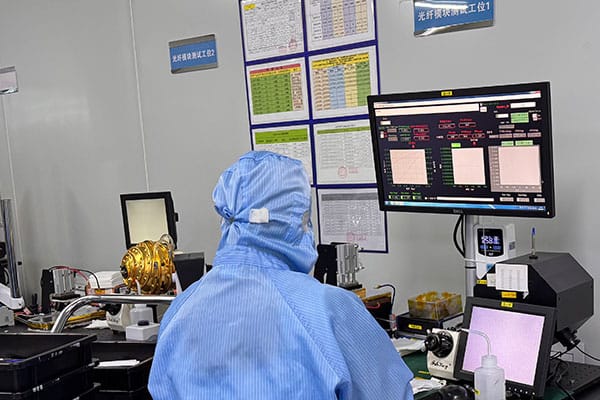
Real-world usage may take years to show signs of degradation. To speed this up, Vivlaser uses accelerated lifetime testing (ALT) techniques, simulating extended use within weeks or months.
Core Testing Methodologies
- Elevated Temperature Testing: Speeds up degradation mechanisms. Commonly tested at 55–85°C ambient conditions.
- Step-Stress Current Testing: Gradually increases operating current to expose weak points.
- Arrhenius Lifetime Modeling22: Converts accelerated data into field-usable life projections using activation energy assumptions.
Benefits for Clients
- Receive pre-qualified product reliability data
- Reduce time-to-market for new product integration
- Use ALT data to align replacement schedules or warranty windows
Vivlaser offers full ALT reports upon request, helping clients make data-driven purchasing decisions.
How Vivlaser Achieves Best-in-Class Reliability
Our commitment to quality is embedded in every phase of product realization:
Advanced Manufacturing
- VBG External Cavity Locking: Ensures spectral stability and wavelength precision (±0.5nm)
- Multi-bar Power Combination: Achieves high-output modules (up to 300W) without thermal compromise
- Precision Assembly: 6-degree-of-freedom alignment with 0.1µm/0.01° resolution
Real Testing, Real Data
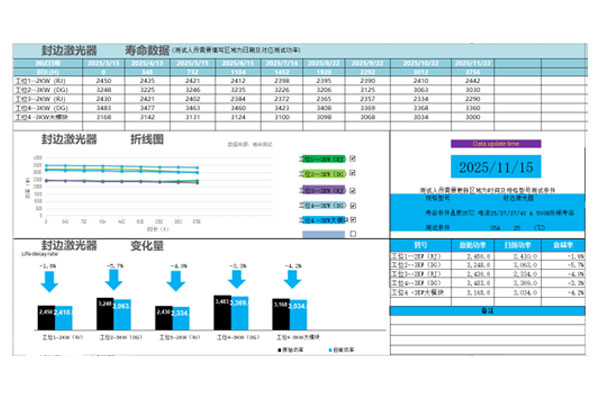
- Example: 80W-880nm laser module subjected to 9.5A current @25°C for over 16,000 continuous hours with no failure
- Ongoing Lifetime Benchmarks: All new designs must pass burn-in thresholds, CP/CPK > 1.33
Designed for Demanding Applications
- Medical: Eye-safe and skin-safe modules with FDA-relevant compliance
- Industrial: Kilowatt-class pump sources for welding, cutting, additive manufacturing
- Research: Custom spectrum designs for Raman, fluorescence, spectroscopy
What This Means for You
If you’re a product manager, integrator, or buyer in the laser technology space:
- Choose a supplier who understands not just how to make lasers—but how they fail
- Use Vivlaser modules to reduce unexpected maintenance and increase customer satisfaction
- Leverage our lifetime data to differentiate your products in performance and longevity
How to Maintain Your Lasers by Reverse-Engineering Failure Symptoms
To avoid costly downtime or equipment damage, users can learn from failure symptoms to implement preventive care:
Symptom: Sudden Output Drop3
- Likely Cause: Random failure (e.g., ESD damage)
- Prevention: Use ESD-safe workstations and handling procedures
- Add transient protection diodes in driving circuits
Symptom: Gradual Power Decline34
- Likely Cause: Aging (wear-out failure)
- Prevention: Regularly monitor output and current draw
- Avoid operating at max-rated current for extended periods
- Keep module within rated temperature range
Symptom: No Output / Open Circuit
- Likely Cause: Catastrophic failure (initial or mechanical shock)
- Prevention: Avoid hot-plugging power cables
- Secure laser modules during transit
- Request factory-installed shock-absorbing mounts
Symptom: Mode Hopping or Wavelength Drift
- Likely Cause: Thermal instability or cavity contamination
- Prevention: Ensure TECs and heat sinks are functioning properly
- Periodically clean optical interfaces if user-accessible
- Maintain proper airflow in system design
By watching the signs, customers can reduce system failures, plan proactive replacements, and ultimately extend the usable life of their laser modules.
Conclusion
At Vivlaser, we turn failure analysis into a competitive advantage. With robust design, advanced aging models, and real-world testing, we deliver more than lasers—we deliver performance you can prove.
- Explore this link to understand how ALT can enhance product reliability and speed up your development process. ↩
- Discover the science behind Arrhenius Lifetime Modeling and its importance in forecasting product durability. ↩
- Understanding the causes of sudden output drops can help you implement effective preventive measures and avoid costly repairs. ↩
- Exploring solutions for gradual power decline can enhance the longevity and performance of your laser systems. ↩