Home-use IPL hair removal devices have become one of the most popular categories in consumer aesthetic electronics. Many users report gradual hair reduction after consistent use over several weeks or months.
A common question naturally follows:
Why do IPL hair removal devices require repeated treatments to achieve lasting results?
The answer lies not in product quality, but in the fundamental physics of how IPL systems deliver optical energy to hair follicles.
How Hair Removal Actually Works
Effective hair removal is based on a principle known as selective photothermal interaction1.
The objective is straightforward:
-
Light energy penetrates the skin
-
Melanin within the hair follicle2absorbs energy
-
Heat accumulates in follicular structures
-
Thermal damage inhibits future hair growth
For long-term reduction, follicle temperature must typically reach approximately 60–70°C for a sufficient duration.
Achieving this condition efficiently depends heavily on wavelength control and energy concentration.
How IPL Systems Generate Light
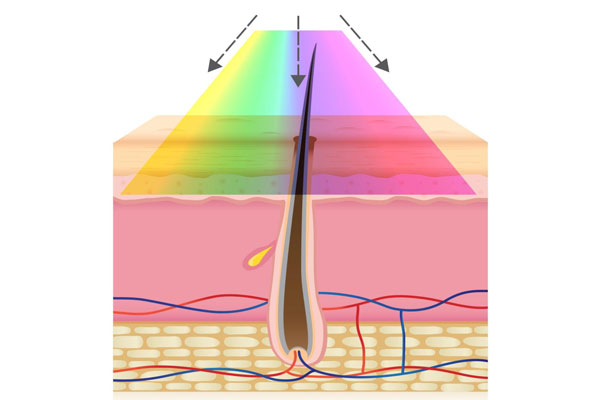
Unlike lasers, IPL (Intense Pulsed Light) systems do not emit a single wavelength.
Instead, IPL devices use a xenon flash lamp3, producing broadband light typically spanning 500–1200 nm. Optical filters remove unwanted spectral regions, leaving part of the spectrum capable of interacting with melanin.
However, this broad emission introduces several engineering limitations of broadband IPL compared to diode lasers4.
Energy Dispersion Across Multiple Wavelengths
Only a portion of IPL output effectively contributes to follicle heating.
Because energy spreads across hundreds of nanometers:
-
Some wavelengths are weakly absorbed by melanin
-
Some are absorbed by superficial tissue
-
Some contribute little therapeutic effect
As a result, the effective energy density reaching the follicle is relatively low5 compared with wavelength-specific laser systems.
Lower thermal accumulation means multiple treatment cycles are required.
Limited Penetration Consistency
Hair follicles exist at varying depths depending on body location and individual skin type6.
Broad-spectrum IPL light experiences different absorption behaviors across wavelengths, leading to inconsistent penetration depth.
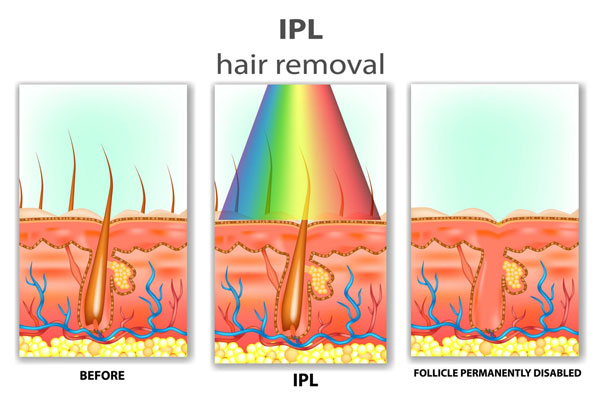
This variation reduces the probability of uniformly heating all active follicles during a single session.
Repeated exposure compensates for this limitation over time.
Hair Growth Cycle Constraints
Another important factor is biological rather than optical.
Hair follicles cycle through three stages:
-
Anagen (growth phase)
-
Catagen (transition phase)
-
Telogen (resting phase)
Only follicles in the anagen phase contain sufficient melanin connected to the growth structure.
Since IPL delivers moderate thermal impact per session, multiple treatments increase the chance of targeting follicles as they enter the growth phase.
Safety-Driven Energy Limits in Home Devices
Consumer IPL systems are intentionally designed with conservative energy output to ensure safe home operation.
Lower fluence levels reduce risks such as burns or pigmentation changes but also limit instantaneous follicle damage.
Repeated treatments therefore become part of the intended operational model rather than a design flaw.
Why Wavelength-Specific Laser Systems Behave Differently

Diode laser systems operate using a single, optimized wavelength, commonly around 808 nm7, where melanin absorption and penetration depth achieve a practical balance.
Because energy is concentrated at one wavelength:
-
Optical efficiency increases
-
Energy delivery becomes predictable
-
Thermal buildup occurs more rapidly within follicles
This allows stronger photothermal interaction during each treatment session.
From an engineering standpoint, wavelength specificity improves energy utilization rather than simply increasing power.
Repeated Treatment Is a System-Level Trade-Off
IPL technology remains widely used because it offers:
-
Large treatment area coverage
-
Lower manufacturing cost
-
High operational safety
-
Simplified system integration
However, these advantages inherently trade off treatment efficiency per session.
Repeated treatments are therefore not a weakness of individual devices, but a consequence of broadband light architecture.
The Evolution of Home Hair Removal Technology
As semiconductor laser technology continues advancing toward higher efficiency and smaller form factors, handheld devices are gradually moving from generalized light exposure toward precision energy delivery.
Miniaturized diode laser modules8 now make it increasingly practical for manufacturers to integrate true laser sources into compact aesthetic platforms.
Companies specializing in compact semiconductor laser technologies, such as Vivlaser, support this transition by enabling laser integration without significantly increasing device size or thermal burden.
Conclusion
IPL hair removal devices require repeated treatments primarily because broadband light distributes energy across many wavelengths, reducing thermal efficiency at the hair follicle.
Understanding this distinction highlights an important industry trend: future home-use aesthetic systems are progressively shifting toward wavelength-controlled laser technologies designed for more efficient energy delivery.
My Insight
Repeated treatments with IPL hair removal devices are not a sign of weak performance — they are a natural consequence of broadband light physics, conservative energy design, and biological hair growth cycles.
Because IPL distributes energy across a wide wavelength range, only a portion effectively contributes to follicle heating. Combined with safety-limited fluence in home-use systems and the need to target follicles during the anagen phase, multiple sessions become structurally necessary to achieve gradual hair reduction.
From an engineering standpoint, this highlights a broader industry shift: as semiconductor laser technology becomes more compact and efficient, wavelength-specific diode systems are increasingly positioned to deliver higher energy utilization and stronger per-session impact.
For manufacturers and OEM brands, the real strategic question is no longer how to optimize broadband output — but how to transition toward precision wavelength control for the next generation of aesthetic devices.
-
Understand the scientific mechanism behind laser hair removal. ↩
-
Learn why melanin is the key target chromophore. ↩
-
Understand the core light source mechanism. ↩
-
Compare IPL limitations with modern diode laser systems. ↩
-
Compare follicular energy delivery between technologies. ↩
-
Understand why follicle depth varies across patients. ↩
-
Learn why 808 nm balances absorption and penetration. ↩
-
Exlpore more miniaturized diode laser module from Vivlaser ↩