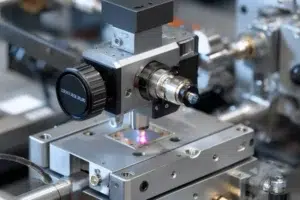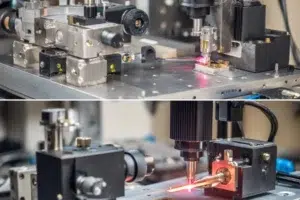
High-resolution laser 3D printing is moving toward micro-scale additive manufacturing with feature sizes below tens of microns. Faster photopolymer resins are enabling higher build speeds without sacrificing detail. Multi-laser systems are increasing production throughput for industrial-scale printing. Improvements in optics, beam control, and materials will expand the range of functional printed components. The next generation of SLA systems will focus on both resolution and productivity.
High-resolution laser 3D printing already produces extremely fine features, but industries now demand even smaller structures and faster production speeds.
Future high-resolution laser 3D printing will combine micro-scale additive manufacturing11, faster photopolymer resins, and multi-laser architectures22 to improve both resolution and industrial productivity.
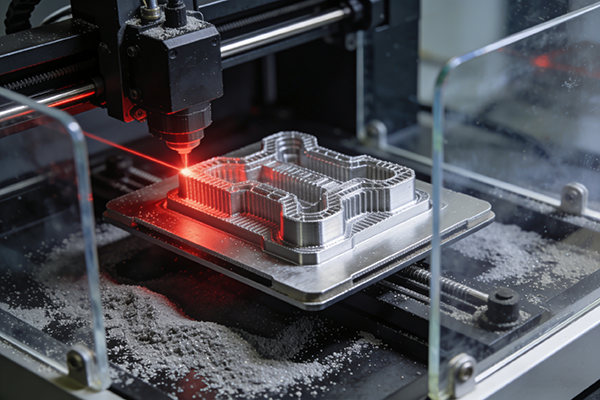
These trends reflect a broader shift in additive manufacturing from prototyping toward scalable production and precision manufacturing.
How Will Micro Additive Manufacturing Change Laser 3D Printing?
Traditional 3D printing focused on millimeter-scale parts, but many emerging applications require micro-scale structures33.
Micro additive manufacturing uses highly focused laser systems and precise optics to fabricate features at the micron scale.
Deep Explanation
Moving from macro printing to micro fabrication
Early SLA printers were designed for relatively large parts such as prototypes or mechanical components. However, new applications in electronics, biomedical engineering, and microfluidics require extremely small features.
Micro additive manufacturing pushes the limits of resolution by combining short wavelengths, precise optics, and sensitive photopolymer chemistry.
These systems can produce structures with feature sizes below 10–20 µm, enabling new types of micro devices that were previously difficult to manufacture.
Applications driving micro-scale printing
Several industries are pushing demand for micro additive manufacturing:
- biomedical implants and scaffolds
- microfluidic diagnostic devices44
- micro-optical components55
- MEMS-like mechanical structures56
These applications require accurate micro-scale geometry and smooth surfaces, which laser-based photopolymerization can provide.
Optical and mechanical challenges
Achieving micron-level resolution requires improvements in multiple engineering areas.
| Engineering Factor | Impact on Micro Printing |
|---|---|
| Laser wavelength | Shorter wavelengths improve resolution |
| Beam quality | Determines focusing precision |
| Optical stability | Prevents drift in micro-scale structures |
| Resin sensitivity | Enables curing with small energy doses |
Because of these challenges, micro additive manufacturing often requires carefully optimized optical systems and tightly controlled resin chemistry.
Engineering Check
“Micro additive manufacturing enables fabrication of structures with features below tens of micrometers.”
Advances in optics and photopolymer chemistry allow SLA systems to reach micron-scale resolution.
“Standard desktop 3D printers can easily produce micro-scale features without specialized optics.”
Achieving micro-scale resolution requires precise optical systems and specialized resins.
Why Are Faster Resins Important for Future SLA Printing?
High-resolution printing often sacrifices speed because small laser spots cure only limited areas.
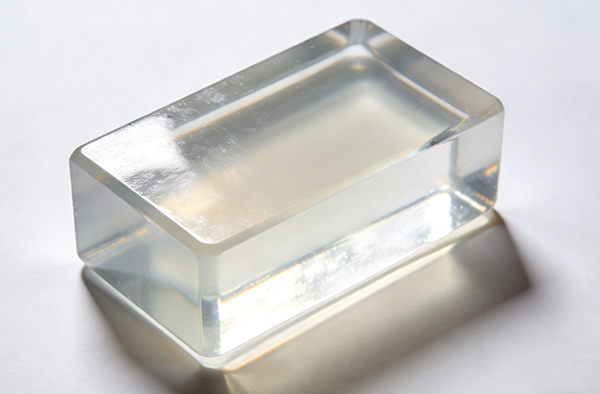
Faster photopolymer resins reduce curing time, enabling higher throughput while maintaining fine detail.
Deep Explanation
Resin chemistry controls curing speed
The curing speed of SLA printing depends strongly on resin formulation. Photoinitiators, monomers, and additives determine how quickly polymerization begins after light exposure.
New resin formulations are being developed to improve polymerization efficiency at specific wavelengths67, especially around 405 nm.
Faster resins require less energy to initiate curing, which allows the laser to move faster while still forming solid layers.
Balancing speed and resolution
While faster resins increase productivity, they also introduce new engineering challenges. If curing occurs too quickly, the polymerization region may spread beyond the intended geometry. This can reduce feature accuracy.
Engineers must balance resin sensitivity with optical resolution to maintain print quality.
| Resin Property | Effect on Printing |
|---|---|
| High photoinitiator efficiency | Faster curing |
| Controlled absorption depth | Accurate layer thickness |
| Low shrinkage | Dimensional stability |
| Stable viscosity | Reliable layer formation |
New material development
Future SLA resins will likely include specialized formulations for different applications78 such as flexible materials, high-temperature polymers, or biomedical materials.
These materials must remain compatible with high-resolution optical systems while improving printing speed and reliability.
Engineering Check
“Resin chemistry strongly influences the curing speed and efficiency of SLA printing.”
Photoinitiator efficiency and resin formulation determine how quickly polymerization occurs.
“Printing speed depends only on laser power and not on resin formulation.”
Resin chemistry significantly affects curing behavior and therefore printing speed.
How Will Multi-Laser Systems Improve Printing Productivity?
High-resolution printing often slows production because a single laser must scan the entire build area.
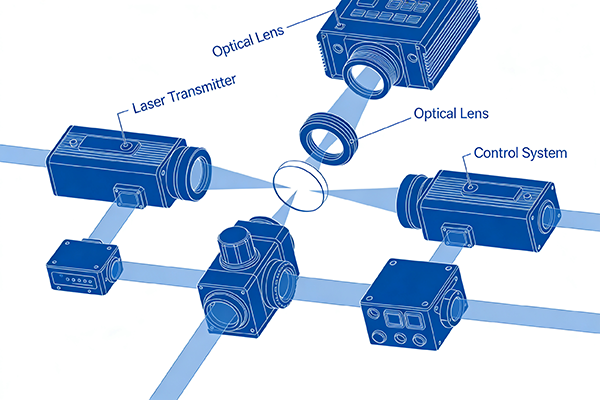
Multi-laser systems increase throughput by allowing multiple beams to cure different regions simultaneously.
Deep Explanation
Parallelizing the printing process
One of the major limitations of laser-based SLA printing is that the laser scans sequentially across the resin surface. This scanning process can become slow for large parts or high-resolution layers.
Multi-laser architectures solve this problem by using several synchronized laser beams operating in parallel. Each beam covers a different section of the build area.
This approach increases build speed without sacrificing optical resolution.
Engineering challenges of multi-laser systems
Operating multiple lasers simultaneously requires precise coordination. If the beams are not aligned correctly, the printed structure may show seams or inconsistent curing between regions.
Engineers must address several technical issues:
- beam synchronization89
- optical alignment910
- energy uniformity
- scanning calibration
Industrial-scale SLA production
Multi-laser systems are particularly valuable for industrial additive manufacturing where throughput is critical.
| System Architecture | Advantage |
|---|---|
| Single laser | Simpler system design |
| Multi-laser | Higher production speed |
| Distributed scanning | Larger build areas |
| Parallel curing | Industrial scalability |
As SLA printing transitions from prototyping to manufacturing, multi-laser architectures will likely become more common.
Engineering Check
“Multi-laser architectures can increase SLA printing throughput by enabling parallel curing.”
Multiple synchronized beams allow larger areas to be processed simultaneously.
“Adding more lasers automatically guarantees perfect print quality.”
Beam synchronization and optical calibration are critical for maintaining consistent curing across the build area.
My Insight
From my perspective, the future of high-resolution laser 3D printing will depend on balancing precision with productivity. Short-wavelength laser systems already enable micron-scale features, but the next stage of development will focus on scaling these capabilities for industrial production. Advances in micro additive manufacturing1011, faster photopolymer resins, and multi-laser architectures1112 will allow printers to achieve both high resolution and high throughput. For manufacturers adopting laser-based additive technologies, the most successful systems will be those that integrate optical precision, material innovation, and scalable system design.
Micro-scale additive manufacturing. ↩
Multi-laser architectures. ↩
Discover cutting-edge medical devices and implants that leverage micro-scale fabrication for improved patient outcomes and advanced diagnostic capabilities. ↩
Discover cutting-edge medical devices and implants that leverage micro-scale fabrication for improved patient outcomes and advanced diagnostic capabilities. ↩
Micro-optical components. ↩
Polymerization efficiency at specific wavelengths. ↩
Specialized formulations for different applications. ↩
Understanding beam synchronization is crucial for achieving seamless prints without visible seams or inconsistent curing between laser regions. ↩
Proper optical alignment ensures consistent energy distribution and prevents print defects in industrial-scale SLA production. ↩
Micro additive manufacturing. ↩
Multi-laser architectures. ↩